Leaving Cert Physics notes updated

This blog has been fairly quiet recently; I have spent every spare minute updating the student notes on the website and feel very proud of my work. I don’t know if anyone else is going to notice mind, but then I guess that’s not the point.

For each chapter I have included all past exam questions, which can be cross-referenced with the relavant marking-scheme which is also included. Also included is  a copy of the associated extracts from the syllabus – this gives the students the responsibility of checking up on me to ensure I have everything covered before moving on to the next chapter.

There is also plenty of “extra-credit” material tucked in at the end to help address many of the conceptual difficulties which students (and teachers!)  have; these also help to set the historical and social context of many of the discoveries. Science is after all a very human activity, dispite what you might think from the text-books and syllabus.

I would hope that students outside of my own school would find these useful, particulary those who don’t have a specialised Physics teacher should find it to be a useful resourse to help them help themselves.

Some would see the decision to allow the students to see their test in advance to be somehow ‘cheating’, but for me it helps overcome one of the biggest obstacles facing many students who may not be in the top bracket; they simply don’t know what to learn. I have found with this new approach that hard-working students who are of average ability have gone from 50% to 75% since I introduced the option. It doesn’t change those at the top; the A-students still get their A’s, while at the other end those determined to do as little as possible still continue to achieve results which reflect this.

But I’m delighted with this practice. We spend at least one class and maybe two going over these questions at the end of each chapter and before I give them the test. Then I simply pick ten questions from the list, while altering the numbers in the maths questions. After seven years of leaving-cert questions (2002 – 2009) there is a pretty comprehensive bank of questions there, so I don’t believe it is giving students an inflated sense of their own worth.

But as an incentive to prepare for class tests and greater student participation it is working like a dream. I’m not too proud to say that I’m thrilled with my work!

Out of the mouths of babes . . .

These are doing the rounds on the email circuit (thanks Ciaran).
Wonderful, yet terribly sad in that we associate these silly answers with young ‘uns, probably because older students have had this lateral thinking ‘educated’ out of them.

TEACHER: John, why are you doing your math multiplication on the floor?
JOHN: You told me to do it without using tables.

TEACHER: Glenn, how do you spell ‘crocodile?’
GLENN: K-R-O-K-O-D-I-A-L’
TEACHER: No, that’s wrong
GLENN: Maybe it is wrong, but you asked me how I spell it.

TEACHER: Donald, what is the chemical formula for water?
DONALD: H I J K L M N O.
TEACHER: What are you talking about?
DONALD: Yesterday you said it’s H to O.

TEACHER: Winnie, name one important thing we have today that we didn’t have ten years ago.
WINNIE: Me!

 TEACHER: Glen, why do you always get so dirty?
 GLEN: Well, I’m a lot closer to the ground than you are.

 TEACHER: Millie, give me a sentence starting with ‘I.’
MILLIE: I is . . .
TEACHER: No, Millie . . .. Always say, ‘I am.’
MILLIE: All right . . . ‘I am the ninth letter of the alphabet.’

TEACHER: George Washington not only chopped down his father’s cherry tree, but also admitted it. Now, Louie, do you know why his father didn’t punish him?
LOUIS: Because George still had the axe?

TEACHER: Now, Simon, tell me frankly, do you say prayers before eating?
SIMON: No sir, I don’t have to, my Mom is a good cook.

TEACHER: Clyde , your composition on ‘My Dog’ is exactly the same as your brother’s. Did you copy his?
CLYDE: It’s the same dog.

 TEACHER: Harold, what do you call a person who keeps on talking when people are no longer interested?
HAROLD: A teacher

Which reminds me of the Ken Robinson talk.
A teacher is watching a six-year old draw and asks what she is drawing. “God”, the kid says.
“But nobody knows what God looks like”.
Kid replies: “they will in a minute”.

Robinson has just published a book on the topic of education and creativity entitled The Element: How Finding Your Passion Changes Everything.

He was interviewed in yesterday’s Guardian:

We put too high a premium on knowing the “single right answer”, Robinson claims. But he says he is not in principle opposed to standardised tests, such as Sats. Used in the right way, they can provide essential data to support and improve education. The problem comes when these tests become more than simply a tool of education and turn into the focus of it, he argues.

CESI conference 2009: Prepare to be inspired

acquia_marina_logo

I’m definitely getting grumpier. As the years go by I get more and more annoyed with the isolation in which we teachers carry out our job. Not only is it possible for us to spend our entire career – from the day we graduate to the day we retire – without once being observed by a collegue or inspector, but similarly there is no onus on us as professionals to show that we are aware of best practice elsewhere, even if elsewhere happens to be the class next door.

Okay, so it’s a slight exaggeration; we do now have department ‘inspections’, but let’s face it – these are highly contrived occasions and are seen almost exclusively as stressful occasions to ‘get over’ rather than opportunities to become reflective of our own teaching.

Last time I checked this was 2009 – the 21st century – and there is still no forum for teachers to share resources, ideas or even ask advice of our colleagues on a country-wide forum. At National School level the INTO have a number of discussion forums for their members, at Secondary level the ASTI have yet to initiate such a concept.
Hopefully the recently formed Teaching Council of Ireland will set something up, or maybe even the Teachers Professional Network, which has given considerable funding to CESI to help run the event.

That’s why CESI is so important for individuals like me. It is primarily for teachers involved in ICT, but it does allow us to acknowledge that there is a wider world out there, composed of professionals who are all trying to improve their teaching. The CESI forum (see the homepage) has grown to over 300 members, and one of its great strengths is that it incorporates all levels of education.

Next Friday and Saturday sees the CESI annual conference in Tallaght. It is one of the very few conferences which I really look forward to. There is a tremendous sense of goodwill and energy pervading the two days and it is impossible not to leave inspired.  And of course what differentiates it from so many other well-intentioned conferences is that the forum allows for immediate follow-up and feedback, ensuring that wonderful ideas don’t slide down the ‘to-do’ list.

I have encouraged colleagues in my own school to attend, but when they ask what’s the big deal about using ICT I struggle to give an articulate answer on the spot. So when Anne-Marie posted this on the forum recently I zoned in on it immediately. She writes better than I ever could about the potential of ICT in teaching. It’s not a case of  ‘what use is ICT’?’, it’s more a case of no matter what you teach, ICT has to potential to improve your teaching, if only you allow yourself to be open to it:

I am a muinteoir Gaeilge and a budding ICT enthusiast. I am very enthusiastic but a real novice with ICT. I began using ICT in the rang Gaeilge last year with three first year  groups.Each student had the option of doing a project in the traditional way or by using the free Photostory software. The majority chose to do a photostory project . It appealed to all levels of ability. I couldn’t believe the students enthusiasm in putting their projects together and how proud they were of the finished product. They were all very keen that everyone would see their films as Gaeilge. This project developed all 4 language skills in a way that few other projects could. It appealed to all students and they enjoyed working on it.There was no struggle getting students to complete work.
 
This year, I have been working on radio programs and editing with a fourth year group as part of the Gael Linn comortas chlar raidio. I am planning to start a module on blogs and Podcasting after mid term. I am not sure whether I am brave or stupid, but the students are enthusiastic and social networking is their world , so the plan is to use this to our advantage in the seomra Gaeilge.
 
I would really love to attend the conference but unfortunately it is not possible. I would very much appreciate any help or suggestions anyone could give me and would love feedback on the conference.

Thanks to Anne-Marie for allowing me to use the quote.

I know the conference falls over mid-term, but I promise you that you will not regret the decision to turn up. Given the recent withdrawal of funding and support from the department, it seems that our greatest resource is each other. Prepare to be inspired.

Teaching Heat in Junior Cert Science

There are a large amount of experiments in this chapter:

  1. Expansion and contraction of solids.
  2. Expansion and contraction of liquids.
  3. Expansion and contraction of gases.
  4. Water is a bad conductor.
  5. Expansion of water on freezing.
  6. Comparison of conduction in various metals.
  7. Convection in liquids.
  8. Convection in gas.
  9. Compare radiation in bright and dark surfaces.
  10. Plotting cooling curves.

This can lead to problems on two fronts:

  1. It can take an inordinate amount of time to get through the chapter.
  2. Students can easily get confused about which experiment goes with which concept.

It makes sense to group experiments into sections, and if possible carry out each set of experiments together.
This does however take a little organisation in advance.
So here we look at the expansion of solids, liquids and gases; the aim is for the students to get through all three in one period, although they would need to be prepared in advance.
Allow a double-class if trying this for the first time, for obvious reasons.
It’s never going to make the best of youtube, but hopefully it will help the teachers in my own science department. I hope to get through the rest soon, and then summarise as best I can on one page using diagrams.

Thanks to my second-year class of  for being amazingly patient.
And thanks to Millie for the brilliant camera-work (can you believe she had never used a camcorder before?!)

Colleagues: Please ensure that the equipment goes back into the correct boxes after.
Pretty please?
With a cherry on top??

Late update: I’ve just seen Tom Healy’s videos of the same expts on youtube, but put together much more lovingly. I reckon they all complement each other nicely!

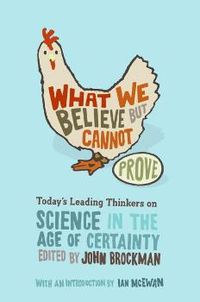
What We Believe But Cannot Prove

200px-whatwebelievebutcannotprove

This is the title of a pretty cool book which I received last year (thanks Jamie and Sarah), with the subtitle; Today’s Leading Thinkers on Science in the Age of Certainty.

It has a very impressive list of contributors including Leon Lederman, Jared Diamond, Steven Pinker and Charles Simonyi. Topics include Physics, Biology, Psychology and Computer Science.

Nobody spoke about what I believe but cannot prove, so I’m sticking it up here.

I beleive but cannot prove that in the next thousand years the number of humans on this planet will drop from where it is now (6.75 billion) to under one hundred thousand, and as a species we may indeed go extinct completely.

I’m genuinely surprised that nobody suggested that at the very least our world will look completely different in one thousand years. Global warming is going to be the main contributory factor. I believe we often overlook the role of climate in instigating conflict in the past. Deteriorating weather means shortage of resources, which in turn results in greater demand for remaining resources (and not just food; land which isn’t submerged and is relatively well-protected from the weather will also become coveted). This will inevitably lead to population movement and all the tragedy that brings with it.

Of course for many countries this is already happening, but fortunately (or unfortunately, depending on how you look at it) most of us have become so de-sensitised that we can’t tell whether the scene we’re watching is real devastion or a Hollywood blockbuster.

And why should we think that as a species we will survive?
99% of all the species that ever existed are now extinct. And contrary to popular belief, being more highly developed doesn’t increase your chances of survival –  it decreases it. The virus is the real sucess story of evolution, not  you and me.

What do you believe but cannot prove?

Neutrinos, John Updike and Cosmic Gall

I’m suspect it may not have been part of his overall plan, but the death of John Updike coincided (can I say ‘nicely’?) with our class on Neutrinos.

There are some strange particles out there, but not many as strange as the neutrino.
Here’s what the syllabus has to say on neutrinos:

If momentum is not conserved, a third particle (neutrino) must be present.

And that’s it.
Here’s what Updike has to say.
This is why scientists need poetry.

Cosmic Gall

NEUTRINOS, they are very small.
They have no charge and have no mass
And do not interact at all.
The earth is just a silly ball
To them, through which they simply pass,
Like dustmaids down a drafty hall
Or photons through a sheet of glass.
They snub the most exquisite gas,
Ignore the most substantial wall,
Cold shoulder steel and sounding brass,
Insult the stallion in his stall,
And scorning barriers of class,
Infiltrate you and me! Like tall
and painless guillotines, they fall
Down through our heads into the grass.
At night, they enter at Nepal
and pierce the lover and his lass
From underneath the bed-you call
It wonderful; I call it crass.

Telephone Poles and Other Poems, John Updike, Knopf, 1960

What a wonderful counter to the claim that Science leads to a loss of wonder due to over-analysis (now replace ‘Science’ with ‘Science Education’ and that’s a different matter.)

Updike is referring to the fact that are about 50 trillion of these buggers passing through us every second! (rounded off to the nearest whole number, obviously).
I need to say more about these guys in a later post; their origins are just as amazing. Maybe I could use a podcast to try and get across the emotion that should be part and parcel of discussing neutrinos.

Anyway I say put that poem on the syllabus. And for the exam itself one word would suffice: “Discuss”.


Why are Science textbooks so boring?

boring-science1

‘ Been thinking about this alot.
Why are Science Textbooks so boring?
Surely it must be possible to write a book that illustrates

  • The WONDER of Science
  • The MYSTERY of Science
  • The POWER of Science
  • The POETRY of Science
  • The BEAUTY of Science

So here’s my plan.

Next time a teacher wants to write a science textbook, he or she must go before an interview board and demonstrate that they have a PASSION for the subject.

The board is to be made up mostly – perhaps exclusively (okay, so I may not have put a lot of thought into this) of non-scientists. The board must contain the following; a poet, an artist and a writer; people who know how to express their emotions and who would be able to judge other peoples’ ability to do the same.
There must be at least one lay-person, and of course lots of children.

Throw in one Simon Cowell and let the games begin.

Conservatives say teaching sex education in the public schools will promote promiscuity. With our education system? If we promote promiscuity the same way we promote math or science, they’ve got nothing to worry about.
Beverly Mickens

Demonstrating how a tele works

Step One: Break the tele

Of course you could just shoot it

Then we looked at the working of the Cathode Ray Tube in a little more detail:
The cool thing about is that it enables us to look at the wave nature of the electron. Given that this (Quantum Theory) is one of the most popular areas of Science, you’d think that it would be on the actual syllabus.

Dear Wife: These are my demands

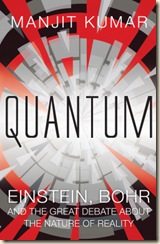
kumar-quantum_thumb1

  1.  
    1. That my clothes and laundry are kept in good order and repair.
    2. That I receive my three meals regularly in my room.
    3. That my bedroom and my office are always kept neat, in particular, that the desk is available to me alone.
    4. You are to renounce all personal relations and refrain from criticising me either in word or deed in front of my children.
    5. You are neither to expect intimacy from me nor reproach me in any way.
    6. You must desist immediately from addressing me if I request it.
    7. You must leave my bedroom or office immediately without protest if I so request.

So who’s the bastard?
None other than the great Albert Einstein; he made these demands of  his first wife Mileva, who actually agreed to the terms.
The marriage didn’t last much longer.

Taken from the wonderful book Quantum, by Manjit Kumar.