Junior Cert Science revision: the experiments

 
With the Junior Cert Science exam just around the corner this resource will come too late for most, but for what it’s worth I am highlighting it here anyway. With over 45 experiments needing to be written up for Coursework A the sheer volume can be quite intimidating, particularly for those of us who are struggling with the subject in the first place.

That’s why I’ve put together a very short summary of all the experiments on the revision page of thephysicsteacher. Each set (Physics, Chemistry and Biology) can fit onto one double-sided page (well almost – need to work on reducting Physics) and if students are looking for a more indepth description they can go to the original notes, which also contain every question which has ever appeared on an exam paper (at Higher and Ordinary level) along the accompanying solutions.

Hope it’s of use to some of you out there.

And remember – real Science bears little or no resemblance to the rubbish you have to learn for this exam, so try not to be put off by the subject.

Military sponsoring Science: let’s just keep that out of our textbooks shall we?

I like to use the following cartoon as an introduction to discussing what science is about.


As for the answer to how science really works – I simply tell students I don’t know, and I’m not sure anybody does.

I’m not even sure we could agree on on a definition of what Science is.

However I think we can agree that military aims has (right from the very beginning) been a strong factor in the advancement of science (but no I can’t quantify the word ‘strong’). Consider the following:

America’s budget crisis is prompting tough discussions about its defence spending, which, at nearly $700 billion, is bigger than that of the next 17 countries combined.
Link

A more important concept that needs to be recognised is why textbooks coveniently ignore this dark side and persist in painting a picture of science that is at odds with reality (disinterested quest for knowledge, great scientists of  the past were pargons of virtue and all that lark).

Actually why the history of science was first portrayed in this idealised light is a fascinating study, but possibly for another day.

This school picture obviously contradicts what we know now. We as teachers should be demanding a more accurate portrayal of our subject (a human endeavour, warts and all) and not to acknowledge this is to do our students a disservice.

We are beginning to row back at least  from presenting science as a font of absolute knowledge and I think that’s where the ‘How Science Works’ theme kicks in, but there is still the murky patronage, both past and present, which needs to be acknowledged.

Junior Cert Science – Graphs and the phrase ‘directly proportional’

Usually there is at least one graph to draw on the Junior Cert Science paper, and if it’s in the Physics section then chances are it will be a straight line graph (the main exception is Cooling Curves). There’s nothing on the syllabus (that I’m aware of) that states that students are expected to know the significance of a straight line graph. In fact here’s a piece of research for you – next time you’re in class ask your students why we’re expected to bother with graphs in the first place. My bet is that very few will be able to give a convincing answer.

One reason we ‘bother’ with graphs is to establish a relationship between two variables; to use the correct jargon we want to see if the variables are ‘directly proportional’ to each other. Now that term ‘directly proportional’ is very important. In means in effect that the two variables are increasing at the same rate. For example if you are on a bicycle travelling at a steady speed of 10 m/s, then for every second that you cycle you will have travelled 10 m (d’oh), and if you travel for twice as long you will cover twice as much ground. If you travel for four and a half times as long, you will cover four and a half times the distance.
So again, the time and the distance covered are increasing at the same rate – they are directly proportional to each other.

The graph is our way of verifying this – it turns out that when you plot all the given data and you end up with a straight line which passes through (0,0) then we can state that the two variables are directly proportional to each other.

So why am I telling you all this now?
Because in the exam you may be asked to draw a graph and then say what the relationship is between the two variables. And if you don’t use the phrase ‘directly proportional’ in your answer then you probably won’t get full marks.
Now as I mentioned I have never seen this phrase highlighted in a Junior Cert textbook so you may well have heard it here first.

Now to help you I have compiled all the graph questions that have ever been asked at Junior Cert into one word document. You can find it on the revision page of thephysicsteacher here (it’s no.3 – Graphs). It also contains all the solutions to the questions, plus a list of do’s and don’ts.

Make sure you check it out before going into the exam. And if you’re reading this as a teacher please remember when photocopying to copy back-to-back and reduce two pages onto one. In doing so you reduce the amount of pages by a factor of 4.

Good luck!

Applied Maths Resources II

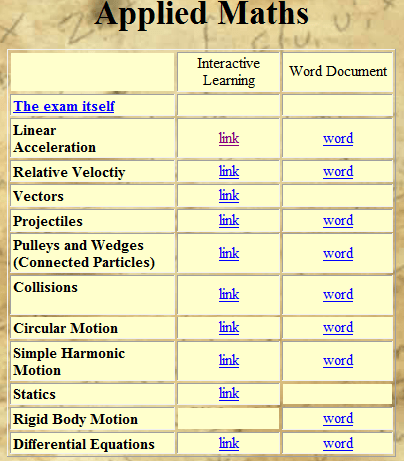
To go with the previous post on Applied Maths papers there is an accompanying set of notes on each topic here.
Many of these are 30 – 40 pages long so don’t print unless you have to; when I distribute these to students I use the photocopier to photocopy two pages onto one (A3 – A4) and also to go double-sided. This reduces the number of pages by a factor of 4.

Each topic has its own contents page at the beginning which breaks the chapter up into sub-topics.  Each sub-topic then has an introduction and some exam questions with worked solutions (or at least most do – it’s still a work in progress). There is then a guide to answering the individual questions (which also includes the answers), although I think this  only goes from 2010 to 1995. Every question from 2010 to 1970 is included in the booklet with similar-type questions arranged together.

If you’re a teacher feel free to copy any or all of this to suit your own purposes; life, as always, is simply too short for anything else.

There is also a 1 page guide to approaching the exam itself on the same page.

Hope it’s useful.

Applied Maths Resources

A bit late in the year perhaps, but for anyone out there studying (or teaching) Applied Maths it might be worth noting that I have uploaded a full set of exam questions in the Exam Material section of the website. These go from 2010 all the way back to 1970. I scanned them in from some old papers I had filed away and then converted them to Microsoft Word so that they can be easily incorporated into other documents (more on that later).

It was an interesting exercise in that up until that point I thought that Applied Maths was one of the very few subjects which required more than simply learning off past questions, but it turns out that if you are prepared to cover the full gamut of questions then almost every question you will see in the 2011 or 2012 paper will be very close in apperance to at least one question which has appeared in the past.

Because I have converted into Microsoft Word there is sure to be the odd typo along the way, which is why  on the same page you can have access to the original papers which I scanned in and uploaded (these only go back to 1976 because the quality of the 1975 – 1970 papers was simply too poor to read after scanning).

In the meantime I am working on a set of solutions for all these – some of which have already been provided by a colleague so it’s a case of trying to fill in the gaps but when I have them I intend to stick them up on the same page – stay tuned, but don’t hold your breath!

Sure to be of use to someone – try to avoid printing these if you can.

And good luck with the study.

Quantum Theory – why do we ignore the mystery?

Isn’t it crazy that one of the most wonderful concepts in Physics – the dual nature of light – doesn’t get a better deal from the leaving cert physics syllabus?
Students are expected to know how to demonstrate that light is a wave, and also to be able to recall Einstein’s interpretation of the Photoelectric effect (which proved that light is a particle) but then there is nothing else about what is one of the greatest mysteries in Physics – how can light be both particle and wave?
Quantum Theory is one of the most popular concepts in popular science books, yet we leave it out altogether.
Isn’t there a responsibility on us as teachers to make our voices heard? Or is it the case that we don’t really care?
The following is a video taken during the Solvay Institute of 1927 – it helps to give some feel for the characters involved (see the Quantum Physics page of thephysicsteacher.ie for a link to this and other related videos).

This is one of my favourite videos on quantum theory – it emphasises the wonder, and that’s always a cool trick when introducing any new physics concept to students.

Nuclear Physics Resouces

For anyone out there interested in educating themselves on all things nuclear. I teach this as two seperate chapters for Leaving Cert Physics. I would like to think that by studying the notes on the two chapters plus watching the associated links you would actually be in a position to answer any leaving cert questions on the topic.

You can download the word documents for the two chapters here (they’re chapters 30 and 31) and the links for the associated videos are beside them but I’ll put them here for convenience:
The Atom and Radioactivity
Fission,Fusion and NuclearEnergy

The nice thing (I think) is that the word documents contain every exam question that has ever appeared on that topic (broken into individual short questions) plus the solution to each question.
At least I think that’s cool.

It means not only can you put yourself in a postion to understand what’s happening in Japan at the moment but it should feel nice to know that you can do leaving cert Physics!

After all, it’s not rocket science (is it?)

Apart from that, the following video serves as a reasonably good source of information although it is by no means comprehensive and doesn’t list the potential dangers, which is what most people want to know.

Finally, a useful timeline of events is available from Mr Reid’s blog here

Normally we cover this topic towards the end of sixth year but this is the perfect time to introduce the concepts to fifth years; I wonder how many teachers chose not to alter their lesson plan because that’s just not the order in which it’s meant to be taught?

Did you know that you won the lottery?

We have always assumed that ‘we’ will be around forever; not only that but we wonder how long it will be before we can colonise other planets and solar systems. We conveniently ignore the fact that our being here in the first place may be nothing more that the fortutitous result of an incredible set of conincidences.

Do you believe that your existence is preordained?
I’m not sure what the postion of the mainstream religions is on this (or even if they have a position) but think about it;  when your mom and dad had sex nine months before you were born that one single ejaculation from your father (I do hope you’re not reading this over your morning cornflakes) contained probably two million healthy sperm – and only one of them got to combine with your mother’s egg.
(Apparently the total number of spermatozoa in the ejaculate should be at least 40 million, but it is quite surprising how many dead and abnormal sperm can be present in a ‘normal’ sample.)

And this combination lead to you. Now if any of those other two million sperm got there ahead of yours then it wouldn’t be you reading this right now – it would be a brother or sister – and you wouldn’t exist! So if your folks had decided to wait until Eastenders was over instead of rushing upstairs in a mad fit of passion then you would not be you – you would be your brother (or sister)! I’m telling you – this stuff is mad. Why had nobody told you this before?

So next time you rip up your lottery ticket and complain that you never win anything just think about this – you’ve already won the lottery, and it couldn’t have been a bigger prize!

I mention this every time I teach human reproduction and challenge students to find a flaw in the argument and if not they they are no longer allowed whine about how hard they have it. I was reminded of it recently when reading The Frog Blog’s recent post on putting the  wonder back into science education.
I have spoken about the concept of wonder before and mentioned that you don’t find wonder in science textbooks or syllabi and as a result it may not be found at all in the science classroom. For this to change those of us who believe it to important need first of all to develop a voice. Are we in a very small minority and if so should we just shut up, or are there others who believe that Science should be about more than merely learning off trivia, all of which could be found at the end of a smartphone in 30 seconds?  
How do we find out who’s with us?
Is twitter the way to go?
Which is more difficult – changing a political system in the Middle East or changing our system of education here in the West?

If Microsoft made Cars

Pulled this down from the internet some time ago – I’m sure it’s been updated many times since if you feel the urge to search:

Bill Gates reportedly compared the computer industry with the auto industry and stated, “If GM had kept up with technology like the computer industry has, we would all be driving $25.00 cars that got 1,000 miles to the gallon.”

In response to Bill’s comments, General Motors issued a press release stating:

If GM had developed technology like Microsoft, we would all be driving cars with the following characteristics:

  1. For no reason whatsoever, your car would crash twice a day.
  2. Every time they repainted the lines in the road, you would have to buy a new car.
  3. Occasionally your car would die on the freeway for no reason. You would have to pull over to the side of the road, close all of the windows, shut off the car, restart it, and reopen the windows before you could continue.
    For some reason you would simply accept this.
  4. Occasionally, executing a manoeuvre such as a left turn would cause your car to shut down and refuse to restart, in which case you would have to reinstall the engine.
  5. Macintosh would make a car that was powered by the sun, was reliable, five times as fast and twice as easy to drive – but would run on only five percent of the roads
  6. The oil, water, temperature, and alternator warning lights would all be replaced by a single “This Car Has Performed An Illegal Operation!”  warning light.
  7. The airbag system would ask, “Are you sure?” before deploying.
  8. Occasionally, for no reason whatsoever, your car would lock you out and refuse to let you in until you simultaneously lifted the door handle, turned the key and grabbed hold of the radio antenna.
  9. Every time a new car was introduced car buyers would have to learn how to drive all over again because none of the controls would operate in the same manner as the old car.
  10. You’d have to press the “Start” button to turn the engine off.