Murray Gell-Mann, the Nobel prize-winning scientist who ‘discovered’ quarks and took the word from Joyce’s Finnegans Wake, thought that Physics at high school was “the dullest course I had ever taken”, and he only applied to study physics at university “to please my father”.
Taken from; When we were kids: how a child becomes a scientist.
I wonder how his physics teacher felt when he read that?
Here Gell-Mann talks about Truth and Beauty in Physics
is a forum for the discussion of important and interesting scientific issues that is much more informal and accessible than a public lecture.
Tomorrow Steve Fuller, Professor of Sociology at University of Warwick will discuss Human Nature:
“There has been undoubtedly a recent rise in interest in biological approaches to understanding the human condition. Many, if not, most of these efforts attempt to reinvigorate the idea of ‘human nature’. But is this idea feasible in light of recent developments in the biological and social sciences? Regardless of the answer one gives, the question raises the larger issue of whether ‘the human’ is itself a category worth defending for scientific or even political purposes. I shall argue that ‘the human’ is indeed worth defending but that much recent thinking and research challenges rather than aids such a project”.
Professor Fuller has indirectly been responsible for introducing me to the schools of History, Philosophy and Sociology of science. I didn’t even know these areas of knowledge existed, but in hindsight this shouldn’t be too surprising; it appears that the Republic of ireland is one of the few countries in the western world which doesn’t have even one of these departments in one of their universities. Queens in Belfast has a History of Science department, or at least they had one ten years ago.
Anyway, back to Fuller; he tends to enjoy provoking scientists out of their comfort zone and forces them to defend not only what they know, but more importantly tries to get them to say why their area of expertise is more secure (‘better’) than other forms.
Lately he has been defending Intelligent Design as a legimate area of knowledge. Here he relates this discussion to the fall-off in the number of students taking Science at secondary level and in college.
What do you do to entertain a class of sixth years who reckon they have earned the right to not work in their final week?
Today I introduced them to the intriguing character of Nikola Tesla
It seemed to go down well.
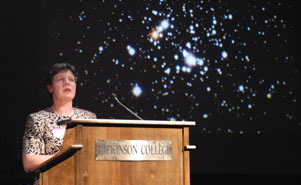
Tomorrow I’m hoping to try getting them to listen to a podcast; in this case it’s an RTE interview with Jocelyn Bell Burnell, an equally intruiging character but for a whole lot of different reasons. She discovered the Pulsar, a rotating neutron star, and should have received a Nobel prize for her work but instead it went to her supervisor. Instead of being bitter she is remarkable sanguine about the whole matter.
Oh, by the way, she’s Irish. So why is this not on the syllabus?
The proram is part of the Icons of Irish Science series, which was first broadcast in 2005, and is well worth listening to.
The Large Hadron Collider (LHC) in CERN will be the world’s largest particle accelerator when its construction is completed sometime this Summer. It’s a pretty big deal if you are a particle physicist, and even if not you are still likely to be bombarded with the news when it is finally switched on.
‘Tips’ aren’t really a good idea for the Leaving Cert Physics paper, but if I had to guess I would suggest that something in this area is going to make an appearance on the Particle Physics question this year.
To find out why this is such a big deal you could do worse than watch Brian Cox talking at TED this year.
The Higgs particle isn’t on the syllabus but it should be. It’s probably the Holy Grail of Particle Physics. It aims to explain why particles have mass, which isn’t as silly as it sounds (apparently).
We had the usual fun with the Van der Graff today. The weather was rather accommodating, and it tallied nicely with the last class before the long weekend.
I have never got a student’s hair to stand up dramatically, but i was drying the canvas belt with a hairdryer when I realised I could help things along a little by aiming it upwards into Fania’s hair. It loosened up the hair very nicely and the show was much more impressive as a result. I also got a student to hold up a mirror so Fania could see for herself what everyone else was laughing at.
I have seen a few examples of Animoto and how it does a pretty cool job of presenting photos, so I thought I’d head on over and check it out.
It really is pretty impressive, and very user-friendly. There might be a couple of thinks I would change, but then again that may just be me not familiar with the program.
It allows for automatic uploading to youtube, which was a pleasant surprise. The free version limits the clip to 30 seconds, so I might just invest in the longer version to check it out.
Many physics students will be familiar with the fact that the prototype kilogram is kept in a high-security vault in Paris. What I didn’t realise was that the mass of this specimen is changing, albeit very slightly.
So here’s the question; if this is the one and only true version of the kilogram, and it loses mass, doesn’t it still stay a kilogram?
And doesn’t that mean that other copies, which would have been correct originally, are now wrong?
(I think in fact that they may all be losing mass slightly.)
Decided it was time to see what I could do with Flickr, so I spent the day taking photos of Junior Cert Science demo apparatus. The plan is that I will show this to students and they will have to name the demonstration. Hopefully it will help the second-years revise for Summer exams. It must be rather daunting to have to go from a year of short class tests, to a set of formal exams which require knowledge taken in over the whole year.
Students can hopefully access this themselves if they wish, although I may print it off for those who don’t have the facilities.
Bloody nice spectrum though innit?
Thanks Conor!
Of course there’s still the bread ‘n butter leaving cert material:
I have been trying to get this to work for years, without success. And then recently I tried it again and lo and behold it worked like a dream!
Part of the problem was that if the day was even slightly humid the gold leaf electroscope wouldn’t hold its charge.
Secondly it had to be charged negatively, and I was never sure if I was charging it positively or negatively.
Thirdly I didn’t realise that I had to sandpaper the zinc in advance to remove the oxide layer.
Fourtly I don’t keep a list of questions related to demonstrations which I can’t get to work, so I only remember that there is a problem when I go to teach it each year, instead of asking an expert.
And I apologise for stating that this is “the most important least impressive experiment in the history of science”. It is actually rather impressive.
If I do say so myself.
There are a whole lot of education blogs out there, but one of the very best has to be Joe Dale’s “Integrating ICT into the MFL classroom“. He gave a presentation at the CESI conference this year and people had to be turned away at the door.
Every subject needs to have a Joe Dale; someone to keep us up to date on best practice in relation to ICT issues, and who you know is a full-time teacher who practices what he preaches.
Here’s my contibution to the ‘Modern Language’ database:
Eddie Izzard – Learning French
‘Course you can’t show this wonderful clip unless you have Youtube.
Don’t mention the war
Is there an equivalent Science / Physics Teacher blog out there?
Patricia Donaghy has done her part; http://edubloggerdir.blogspot.com/ is a registration page for educational blogs where you can go and search by topic.
I guess over time more teachers will get the hang of this sharing lark.
I’m not RIchard Dawkins biggest fan (I know; like he’s worried); for someone who holds the Charles Simonyi Professorship in the Public Understanding of Science he seems to take enormous delight on slighting those he disagrees with – particularly in relation to Creationism.
However it is in relation to extolling the wonder of science that he excels. Consider the following as part of the job description:
The goal is for the public to appreciate the order and beauty of the abstract and natural worlds which is there, hidden, layer-upon-layer. To share the excitement and awe that scientists feel when confronting the greatest of riddles. To have empathy for the scientists who are humbled by the grandeur of it all.
Take any of the wonderful ideas Dawkins speaks about in the clip above and have fun looking for it in a Science syllabus.
Thanks to Peter Kinvara for pointing me in the right direction to find this in a comment on a related posting
The clip is obviously from youtube because for some reason ted.com doesn’t allow video embedding.




 Think for Yourself