I posted very few videos on youtube last year, and am determined to rectify that this year, and in particular to put up some clips of Junior Cert classes.
Here are a couple on spherical mirrors:
The mirrors in this next one were purchased from educationalinnovations for about €20. They have a larger, 22 inch version for $1,195. Just a little out of our budget.
Starting with four basic questions (that you may be surprised to find you can’t answer), Jonathan Drori looks at the gaps in our knowledge — and specifically, what we don’t know about science that we might think we do.
So goes the blurb for the one of the latest talks on TED. Drori asks four basic questions:
1. Where does the “stuff” in trees come from?
2. Can you light a torch bulb with a bulb, battery and a single piece of wire?
3. Why is it hotter in Summer than in Winter?
4. What is the shape of the planets’ orbits?
How many can you answer correctly?
Drori then refers to a couple of videos he was involved in producing a few years ago where graduates of MIT were recorded giving their answers to some of these questions, and surprise surprise, almost all were unable to answer any question correctly. There is a nice moment when one young woman, on finding that she is incapable of puting the electric circuit together, justifies her lack of knowledge by saying “I’m not an electrical engineer, I’m a mechanical engineer”.
Drori wasn’t able to use the clips in his presentation due to a technical hiccup, but I am assuming that these are the videos he is referring to. The first is entitled “Can we believe our eyes?”, while the second is “Lessons from thin air”.
I referred to these videos in a post last year, and mentioned that the answers given by graduates were very similar to those given by six year olds. What I didn’t realise is that, according to Drori, research shows that concepts likeMagnetism and Gravity are betterunderstood by children before they go to school than afterwards!
This is stunning, and a little difficult to believe. I would like to find out where he got his information here, but then again, just because it goes against common sense isn’t reason enough to disregard it.
Another question asked in the “Can we believe our eyes?” video goes something like this;
Imagine you are facing a mirror. If you want to see more of your body should you move towards the mirror, away from the mirror, or does it not make any difference?
The point being made here is that ‘hands-on’ experience is not necessarily very educational. They even received incorrect answers from the barbers who work with mirrors every day. It reminded me of the recent fascinating discovery that cattle and wild deer tend to align their bodies in a North-South direction when standing in a field (link). How could we not have noticed that before?
I guess if we are not directly interested in something (almost at an emotional level) then we are rather unlikely to notice or form a deep understanding of it, and the traditional teaching approach of simply repeating the class lesson is of little use in changing that.
I know myself that I learned bugger-all physics in six years of secondary school or four years of college. I did however learn more in one year of teaching Leaving Cert Physics than I did in all the others combined. This was obviously because I was no longer ‘learning’ to pass an exam, but rather I was learning to survive in a classroom where I knew I would be taking questions from students who were expecting nothing less than an A1 in their Leaving Cert. I had taught in a previous school but had spent too many lessons ‘winging it’ and getting caught out, so for me this was a fresh start and therefore there was certainly an emotional motivation.
Which is why, if I find out that my students know less about magnetism and gravity now than they did before I taught them, I may just have to find a cold, dark room and lock myself in it for a long time.
The Large Hardon Collider is due to be turned on this day next week (Wednesday, 10th of September), so it’s not a bad time to put together some useful resources to show to the troops to give them some idea of what it’s all about.
At just under 5 minutes, the Large Hadron Rap isn’t a bad place to start:
The ‘rappers’ mention dark energy and dark matter; comprising 96% of the universe between them, they can’t be directly measured, but their influence is immense. Find out more by watching Patricia Burchat speak at TED:
Want more? Try ‘Most of the Universe is Missing‘
Mary Mulvihill over at Science@Culture reminds us that BBCRadio 4 is devoting the entire day to the event. Watch Dara O’Briain, among others, give his rather unique take on the event. Not a big fan of homeopathy or Deepak Chopra is our Dara. He does appear to be a fan of Physics though; ‘wonder how he got on with Science in school? He strikes me as someone I’d have to keep on when it came to handing out chemicals!
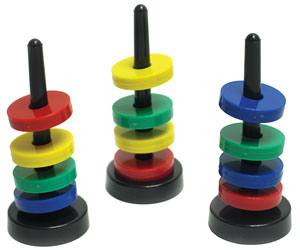
Floating rings used to demonstrate magnetic repulsion
Sometimes the most basic question can be the hardest to answer. “How do magnets work?” is one such question. If you’re a teacher like me you’ll probably end up using fancy terms like “North and South Poles” and “Opposite Poles Attract”, and may even go on to demonstrate it using the floating magnets above.
Or if it’s a senior class you might talk about the material having “Magnetic Domains” which are usually randomly oriently but in a magnet are all lined up parallel.
And this invaribly works.
But there’s usually one student (quite often it’s someone who is not great academically, and consequently may remain in the background for much of the time) who’s not happy with this.
But how does one magnet know that the other magnet is there?
And that, my friends, is a great moment. It means that at least one person in my class managed to avoid all the ‘education’ that I stuff down their throats, and maintained his ability to think for himself. ‘Course that won’t help him (or her) much when it comes to exam time, but at least in my mind it counts for a lot.
A former student once sent me a card on which he wrote “Thanks sir, I was in your class for two years and in that time I learnt nothing”. It was one of the nicer compliments I have received. Cheers Luke.
I hope to be teaching more Junior Cert Science this year and need to remember to avoid the temptation of throwing in jargon as a substitute for deeper explanations. For that matter, when the apple falls from the tree how does it ‘know’ which way is down?
Or here’s one for leaving cert students: why is the charge of a proton (which is composed of three quarks) the same as the charge of an electron if they are completely seperate particles?
Here’s a lovely article taken from the science magazine Discover detailing how the author realises that nobody actually understands how magnetism works.
As teachers, we need to become comfortable discussing the limitations of what we know.
Murray Gell-Mann, the Nobel prize-winning scientist who ‘discovered’ quarks and took the word from Joyce’s Finnegans Wake, thought that Physics at high school was “the dullest course I had ever taken”, and he only applied to study physics at university “to please my father”.
Taken from; When we were kids: how a child becomes a scientist.
I wonder how his physics teacher felt when he read that?
Here Gell-Mann talks about Truth and Beauty in Physics
is a forum for the discussion of important and interesting scientific issues that is much more informal and accessible than a public lecture.
Tomorrow Steve Fuller, Professor of Sociology at University of Warwick will discuss Human Nature:
“There has been undoubtedly a recent rise in interest in biological approaches to understanding the human condition. Many, if not, most of these efforts attempt to reinvigorate the idea of ‘human nature’. But is this idea feasible in light of recent developments in the biological and social sciences? Regardless of the answer one gives, the question raises the larger issue of whether ‘the human’ is itself a category worth defending for scientific or even political purposes. I shall argue that ‘the human’ is indeed worth defending but that much recent thinking and research challenges rather than aids such a project”.
Professor Fuller has indirectly been responsible for introducing me to the schools of History, Philosophy and Sociology of science. I didn’t even know these areas of knowledge existed, but in hindsight this shouldn’t be too surprising; it appears that the Republic of ireland is one of the few countries in the western world which doesn’t have even one of these departments in one of their universities. Queens in Belfast has a History of Science department, or at least they had one ten years ago.
Anyway, back to Fuller; he tends to enjoy provoking scientists out of their comfort zone and forces them to defend not only what they know, but more importantly tries to get them to say why their area of expertise is more secure (‘better’) than other forms.
Lately he has been defending Intelligent Design as a legimate area of knowledge. Here he relates this discussion to the fall-off in the number of students taking Science at secondary level and in college.
What do you do to entertain a class of sixth years who reckon they have earned the right to not work in their final week?
Today I introduced them to the intriguing character of Nikola Tesla
It seemed to go down well.
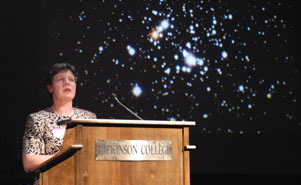
Tomorrow I’m hoping to try getting them to listen to a podcast; in this case it’s an RTE interview with Jocelyn Bell Burnell, an equally intruiging character but for a whole lot of different reasons. She discovered the Pulsar, a rotating neutron star, and should have received a Nobel prize for her work but instead it went to her supervisor. Instead of being bitter she is remarkable sanguine about the whole matter.
Oh, by the way, she’s Irish. So why is this not on the syllabus?
The proram is part of the Icons of Irish Science series, which was first broadcast in 2005, and is well worth listening to.
The Large Hadron Collider (LHC) in CERN will be the world’s largest particle accelerator when its construction is completed sometime this Summer. It’s a pretty big deal if you are a particle physicist, and even if not you are still likely to be bombarded with the news when it is finally switched on.
‘Tips’ aren’t really a good idea for the Leaving Cert Physics paper, but if I had to guess I would suggest that something in this area is going to make an appearance on the Particle Physics question this year.
To find out why this is such a big deal you could do worse than watch Brian Cox talking at TED this year.
The Higgs particle isn’t on the syllabus but it should be. It’s probably the Holy Grail of Particle Physics. It aims to explain why particles have mass, which isn’t as silly as it sounds (apparently).
We had the usual fun with the Van der Graff today. The weather was rather accommodating, and it tallied nicely with the last class before the long weekend.
I have never got a student’s hair to stand up dramatically, but i was drying the canvas belt with a hairdryer when I realised I could help things along a little by aiming it upwards into Fania’s hair. It loosened up the hair very nicely and the show was much more impressive as a result. I also got a student to hold up a mirror so Fania could see for herself what everyone else was laughing at.
I have seen a few examples of Animoto and how it does a pretty cool job of presenting photos, so I thought I’d head on over and check it out.
It really is pretty impressive, and very user-friendly. There might be a couple of thinks I would change, but then again that may just be me not familiar with the program.
It allows for automatic uploading to youtube, which was a pleasant surprise. The free version limits the clip to 30 seconds, so I might just invest in the longer version to check it out.





 Think for Yourself