Education

The mystery of magnetism

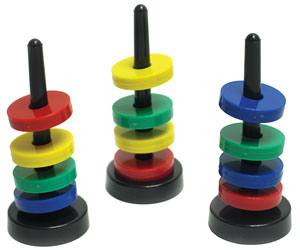
Floating rings used to demonstrate magnetic repulsion

Sometimes the most basic question can be the hardest to answer. “How do magnets work?” is one such question. If you’re a teacher like me you’ll probably end up using fancy terms like “North and South Poles” and “Opposite Poles Attract”, and may even go on to demonstrate it using the floating magnets above.

Or if it’s a senior class you might talk about the material having “Magnetic Domains” which are usually randomly oriently but in a magnet are all lined up parallel.
And this invaribly works.
But there’s usually one student (quite often it’s someone who is not great academically, and consequently may remain in the background for much of the time) who’s not happy with this. 
But how does one magnet know that the other magnet is there?

And that, my friends, is a great moment. It means that at least one person in my class managed to avoid all the ‘education’ that I stuff down their throats, and maintained his ability to think for himself. ‘Course that won’t help him (or her) much when it comes to exam time, but at least in my mind it counts for a lot.

A former student once sent me a card on which he wrote “Thanks sir, I was in your class for two years and in that time I learnt nothing”. It was one of the nicer compliments I have received. Cheers Luke.

I hope to be teaching more Junior Cert Science this year and need to remember to avoid the temptation of throwing in jargon as a substitute for deeper explanations. For that matter, when the apple falls from the tree how does it ‘know’ which way is down?

Or here’s one for leaving cert students: why is the charge of a proton (which is composed of three quarks) the same as the charge of an electron if they are completely seperate particles?

Here’s a lovely article taken from the  science magazine Discover detailing how the author realises that nobody actually understands how magnetism works.

As teachers, we need to become comfortable discussing the limitations of what we know. 

Science, evolution and creationism (again)

I have written before about creationism and science education, and how it is not mentioned in Junior Cert Science. Every so often these surveys appear in the papers; this one was in the New Scientist last May. Researchers polled a random sample of nearly 2000 high-school science teachers across the US in 2007:

[ ] asked about the teachers’ personal beliefs . . . 16% of the total said they believed human beings had been created by God within the last 10,000 years.

I guess the number shouldn’t be surprising, but I can’t help but feel a little uncomfortable.

Fun with magnets

I have a couple of old CRT televisions at the back of the lab, and bring them out to show what happens when you put a rare-earth magnet in front of them. However I obviously lack the imagination to come up with a show like this. I’ll be more adventurous next time; turn off the lights, turn on the trippy music, burn a few incense candles . . .

Course if I really needed to get the troops interested in Magnetism all I would need is a frog and a very strong magnet.

Templates from chutedesign and googledocs

So your whole lesson plan revolves around your students drawing graphs, but just at the last minute you realise you haven’t any graphpaper left.

Never fear – chutedesign to the rescue!

You can even choose the blank paper option:

Blank Paper – for those who cant open that damned printer to get a blank page out!

Now hasn’t that just made your day


And while you’re at it, check out the new Google Docs Templates: grading sheets, attendance sheets, class schedules and lots more. ‘Sure to be at least something there which you could use over the coming year.

Ten great ideas revisited

The amazing thing about our science education is not that so many run away from it, but rather that any at all stick with it. We really do an exceptional job of sucking out all the good stuff.

There must be a website out there somewhere concentrating on the most wonderful ideas in science for the non-specialist, but I haven’t been able to find it.

So I’m going to do one.

Ten ideas. I’m sure the number will grow. Then link each to relevant external resources; these must be interesting, informative and aimed at an appropriate level.
For project work I could maybe get students to pick one which interests them, research it in detail and report back to the class.

Because I am fascinated by science, and am sick to death of teaching students how to measure the density of a stone.

I have put together a word document on this for a recent Fourth Year test; it’s a start.

Murray Gell-Mann – why I took Physics

Murray Gell-Mann, the Nobel prize-winning scientist who ‘discovered’ quarks and took the word from Joyce’s Finnegans Wake, thought that Physics at high school was “the dullest course I had ever taken”, and he only applied to study physics at university “to please my father”.
Taken from; When we were kids: how a child becomes a scientist.

I wonder how his physics teacher felt when he read that?

Here Gell-Mann talks about Truth and Beauty in Physics


Dublin Alchemist Cafe: Professor Steve Fuller

Hope to take myself into the city tomorrow for a little intellectual stimulation.

The Dublin Alchemist Cafe, as it says itself:

is a forum for the discussion of important and interesting scientific issues that is much more informal and accessible than a public lecture.

Tomorrow Steve Fuller, Professor of Sociology at University of Warwick will discuss Human Nature:

“There has been undoubtedly a recent rise in interest in biological approaches to understanding the human condition. Many, if not, most of these efforts attempt to reinvigorate the idea of ‘human nature’.  But is this idea feasible in light of recent developments in the biological and social sciences?  Regardless of the answer one gives, the question raises the larger issue of whether ‘the human’ is itself a category worth defending for scientific or even political purposes. I shall argue that ‘the human’ is indeed worth defending but that much recent thinking and research challenges rather than aids such a project”.

Professor Fuller has indirectly been responsible for introducing me to the schools of History, Philosophy and Sociology of science. I didn’t even know these areas of knowledge existed, but in hindsight this shouldn’t be too surprising; it appears that the Republic of ireland is one of the few countries in the western world which doesn’t have even one of these departments in one of their universities. Queens in Belfast has a History of Science department, or at least they had one ten years ago.

Anyway, back to Fuller; he tends to enjoy provoking scientists out of their comfort zone and forces them to defend not only what they know, but more importantly tries to get them to say why their area of expertise is more secure (‘better’) than other forms.

Lately he has been defending Intelligent Design as a legimate area of knowledge. Here he relates this discussion to the fall-off in the number of students taking Science at secondary level and in college.

Last-week-of-term activities

What do you do to entertain a class of sixth years who reckon they have earned the right to not work in their final week?
Today I introduced them to the intriguing character of Nikola Tesla

It seemed to go down well.


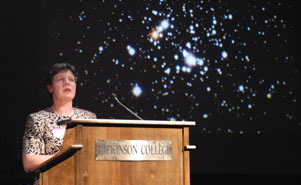
Tomorrow I’m hoping to try getting them to listen to a podcast; in this case it’s an RTE interview with Jocelyn Bell Burnell, an equally intruiging character but for a whole lot of different reasons. She discovered the Pulsar, a rotating neutron star, and should have received a Nobel prize for her work but instead it went to her supervisor. Instead of being bitter she is remarkable sanguine about the whole matter.

Oh, by the way, she’s Irish. So why is this not on the syllabus?

The proram is part of the Icons of Irish Science series, which was first broadcast in 2005, and is well worth listening to.


My tip for the Leaving Cert Physics paper

The Large Hadron Collider (LHC)  in CERN will be the world’s largest particle accelerator when its construction is completed sometime this Summer. It’s a pretty big deal if you are a particle physicist, and even if not you are still likely to be bombarded with the news when it is finally switched on.

‘Tips’ aren’t really a good idea for the Leaving Cert Physics paper, but if I had to guess I would suggest that something in this area is going to make an appearance on the Particle Physics question this year.

To find out why this is such a big deal you could do worse than watch Brian Cox talking at TED this year.
The Higgs particle isn’t on the syllabus but it should be. It’s probably the Holy Grail of Particle Physics. It aims to explain why particles have mass, which isn’t as silly as it sounds (apparently).

‘Course I could be completely wrong.


Learning to podcast

This is a short audio about forces for my Second Year students revising for Summer Exams. I did a bit of podcasting a few years ago but have forgotten how I made the pieces accessable. I also need to learn how to jazz these things up a bit.
This piece is hosted on the wordpress site itself, but I’d like to make it accessable via itunes. I tried this and five days ago received the following

Your podcast feed, [ https://ozymandias1.wordpress.com/feed/ ] was successfully added and is now under review.

Since then, nothing.

forcesone