How to get 100% in your Leaving Cert Physics exam. Part 2: Answering Graph Questions

The following can be downloaded as a word document here

Drawing the graph

  • You must use graph paper and fill at least THREE QUARTERS OF THE PAGE.
  • Use a scale which is easy to work with i.e. the major grid lines should correspond to natural divisions of the overall range.
  • LABEL THE AXES with the quantity being plotted, including their units.
  • Use a sharp pencil and mark each point with a dot, surrounded by a small circle (to indicate that the point is a data point as opposed to a smudge on the page.
  • Generally all the points will not be in perfect line – this is okay and does not mean that you should cheat by putting them all on the line. Examiners will be looking to see if you can draw a best-fit line – you can usually make life easier for yourself by putting one end at the origin. The idea of the best-fit line is to imagine that there is a perfect relationship between the variables which should theoretically give a perfect straight line. Your job is to guess where this line would be based on the available points you have plotted.
  • Buy a TRANSPARENT RULER to enable you to see the points underneath the ruler when drawing the best-fit line.
  • DO NOT JOIN THE DOTS if a straight line graph is what is expected. Make sure that you know in advance which graphs will be curves.
  • BE VERY CAREFUL drawing a line if your ruler is too short to allow it all to be drawn at once. Nothing shouts INCOMPETENCE more than two lines which don’t quite match.
  • Note that examiners are obliged to check that each pint is correctly plotted, and you will lose marks if more than or two points are even slightly off.
  • When calculating the slope choose two points that are far apart; usually the origin is a handy point to pick (but only if the line goes through it).
  • When calculating the slope DO NOT TAKE DATA POINTS FROM THE TABLE of data supplied (no matter how tempting!) UNLESS the point also happens to be on the line. If you do this you will lose beaucoup de marks and can kiss goodbye any chance of an A grade.


What goes on what axis?

Option one

To show one variable is proportional to another, the convention is to put the independent variable on the x–axis, and the dependant variable on the y-axis, (from y = fn (x), meaning y is a function of x). The independent variable is the one which you control.


Option two

If the slope of the graph needs to be calculated then we use a difference approach, one which often contradicts option one, but which nevertheless must take precedence. In this case we compare a formula (the one which connects the two variables in question) to the basic equation for a line: y = mx.

See if you can work out what goes on what axis for each of the following examples (they get progressively trickier):

  1. To Show Force is proportional to Acceleration
  2. Ohm’s Law
  3. Snell’s Law
  4. Acceleration due to gravity by the method of free-fall
  5. Acceleration due to gravity using a Pendulum


There is usually a follow-up question like the following;

“Draw a suitable graph on graph paper and explain how this verifies Snell’s Law”.

There is a standard response to this;

“The graph of Sin i against Sin r resulted in a straight line through the origin (allowing for experimental error), showing Sin i is directly proportional to Sin r, and therefore verifying Snell’s Law”.


If you are asked any questions to do with the information in the table, you are probably being asked to first find the slope of the graph, and use this to find the relevant information.


How to get 100% in your Leaving Cert Physics exam. Part 1: Section A

Section A counts for 30% of your overall mark and is the easiest section to pick up full marks. There are about 24 experiments but many of them are minor variations on each other. Stop wasting time trying to predict which ones will come up and just learn them all. Take one or two per night and make sure you can answer every question on each experiment from past papers. In particular you need to use the following as a checklist for each experiment.

(i)     Draw a fully labelled diagram which includes all essential apparatus (have you included the apparatus necessary to obtain values for both variables?).

(ii)   Be able to state how the two sets of values were obtained (this is a very common question).

(iii) Describe what needs to be adjusted to give a new set of data

(iv) Write down the relevant equation if there is one associated with the experiment.

(v)   Be able to state how the data in the table will need to be adjusted.

(vi) Know what goes on each axis.

(vii)           Know how to use the slope of the graph to obtain the desired answer.

(viii)         Be able to list three sources of error/precautions.

Misc Points

  • The graph question is usually well worth doing.
  • Learn the following line off by heart as the most common source of error: “parallax error associated with using a metre stick to measure length / using a voltmeter to measure volts etc”.
  • Make sure you understand the concept of percentage error; it’s the reason we try to ensure that what we’re measuring is as large as possible.
  • There is a subtle difference between a precaution and a source of error – know the distinction.
  • When asked for a precaution do not suggest something which would result in giving no result, e.g. “Make sure the power-supply is turned on” (a precaution is something which could throw out the results rather than something which negates the whole experiment).
  • To verify Joule’s Law does not involve a Joulemeter
  • To verify the Conservation of Momentum – the second trolley must be at rest.
  • To verify the laws of equilibrium – the phrase ‘spring balance’ is not acceptable for ‘newton-metre’.
  • To measure the Focal length of a Concave Mirror or a Convex Lens.
    Note that when given the data for various values of u and v, you must calculate a value for f in each case, and only then find an average. (As opposed to averaging the u’s and the v’s and then just using the formula once to calculate f). Apparently the relevant phrase is “an average of an average is not an average”.

I have a document here which containts exam questions on every experiment which has ever appeared on a past paper from 2002 to 2010 (Higher Level and Ordinary Level) – this should be your bible for Section A over the coming weeks. Solutions are also included.

Now get back to work.

More to come.

Imagine if the key-word in the Leaving Cert Physics syllabus was ‘wonder’

This is an image, courtesy of Wordle.net, of the current Leaving Certificate Physics syllabus. Wordle is a program that gives the most common words the largest font size:

This is a similar image of the proposed new syllabus.

Notice the new focus on the words ‘learners’ and ‘learning’.

Imagine if a syllabus had as its most common words the following:

Engage

Passion

Awe

Curiousity

Inspire

Un-nerve

Emotion

Story

Creativity

Wonder

If any of this was a priority then chances are that Particle Physics wouldn’t have been removed (and with it Pair Annihilation, Anti-matter, Neutrinos, Fundamental Forces, etc.).

Chances are that Cosmology would also feature strongly in the new syllabus (Black Holes, Quasars, Pulsars, Big Bang, Neutrinos (again), Dark Matter, Alien Life, etc. etc.). It doesn’t.

Maybe it’s just me.

Junior Cert Science – answering graph questions

Since this science course was first examined in 2006 graph questions have become quite common. If you know how to answer them they can be a source of very easy marks but if you’re not familiar with them you can similarly lose a lot of marks just by not knowing some simple rules. And remember there is no choice on the paper!

There are different types of graph questions and you have probably covered many of them in maths anyway. It’s just that the science textbooks don’t seem to do a very good job of telling us why we have them in the first place, or why there are different types.

The graphs you need to be familiar with:

  1. Distance-time graphs
  2. Velocity-time graphs
  3. Voltage-current graphs
  4. Force-extension graphs
  5. Cooling curves
  6. Solubility curves

As you can see these are almost all from the Physics section of the course, and unless you have practiced answering exam-questions they can seem rather intimidating. The link below is to a document which contains all recent exam questions on graphs at Higher Level and Ordinary Level and also includes the solutions. The nice thing is that once you’ve done one or two questions on a given graph they all tend to repeat after that.

There is lots of other advice on answering the graph question, but it’s all in the document itself.

Hope it’s useful!

Revision – Graphs

Assessment in Junior Cert Science – what a shambles; what a cod!

Here’s how to get 35% of your Junior Cert Science mark without having to learn any Science:

  1. Get the first 10% by having your lab book written up – it’s automatic and doesn’t necessarily mean you did any experiments. It certainly doesn’t mean you learnt anything; in fact if you missed out on any expeiments just copy them from somebody else and make up a date (try to ensure it was a day when the school was open).
    Technically we the teachers shuldn’t be signing off on this section unless we know it represents a fair reflection of the students’ actual work, but in practice this is rarely going to be the case. it may be that we see the results our students get as a reflection of our own teaching ability; we may have inherited the students from other teachers or indeed schools so may have no way of knowing how much of the previous work is legitimate; it may be a task too many for already busy teachers to monitor, particulary if the students themselves have little regard for the excercise or simply lack the necessary organisational skills to keep up to date themselves.
  2. Get the next 25% by having your two designated investiagations written up in the correct format. This isn’t very difficult and the average mark here is about 90%. The important thing to remember here is that it doesn’t matter how well you did the actual investigations or how clever your approach was (or indeed if you bothered to do the investigations yourself in  the first place) – all the marks here go for how you write it up.

If you think the final mark that students actually obtain may be somewhat inflated by the hoop-jumping above, you’re not alone. In fact some of us would go so far as to think it makes a mockery of the whole subject at this level.

Rules for National Schools

Rule 68

“Of all the parts of a school curriculum Religious Instruction is by far the most important, as its subject-matter, God’s honour and service, includes the proper use of all man’s faculties, and affords the most powerful inducements to their proper use. Religious Instruction is, therefore, a fundamental part of the school course, and a religious spirit should inform and vivify the whole work of the school.

The teacher should constantly inculcate the practice of charity, justice, truth, purity, patience, temperance, obedience to lawful authority, and all the other moral virtues. In this way he will fulfil the primary duty of an educator, the moulding to perfect form of his pupils’ character, habituating them to observe, in their relations with God and with their neighbour, the laws which God, both directly through the dictates of natural reason and through Revelation, and indirectly through the ordinance of lawful authority, imposes on mankind.”

See the full set of rules here.
Apparently these rules are under review.

Hmmmm . . . .

Some wonderful demonstrations using an inexpensive pressure pump

Available for about €20 from amazon.co.uk

I’m thinking of getting about 8 to act as a class set, and a few more for presents to nephews and nieces.

The ‘Presssure and Sound’ demo can be done with mobile phones as I suggest – the sound level does drop noticealbly in the classroom, but not enough to be picked up by the camcorder.

I presume it would also go down well on Open Day.

Limitless potential.
Eoghan in Second Year suggested using coke to see if it goes flat – I won’t tell you the answer but it’s worth checking out. In hindsight we should have tried to guess what we would have observed.

Then we wondered if the pH would change.

Then we wondered if the level of Carbon Dioxide in the chamber would increase noticealby, even as we pumped out the air. I need to see if we can use a datalogger to see how the  concentration of the gas changes in real time on a laptop.

Then I mentioned that we need to buy lots of marshmallows to see which work the best.

Then Robyn said that she cooks marshmallows at home, so now she has promised to bring in the ingredients and we will try to cook them in school and see if we can make giant ones!

All for €20 plus the price of few marshmallows, balloons and shaving foam.


A short history of the term ‘Voltage’

Image created with wordle.net

Potential difference (commonly known as ‘voltage’) is probably one of the least well understood concepts in Leaving Cert Physics.

Not only is it difficult to understand such an abstract concept (it’s not like you can hold a bunch of voltage in your hand), but the meaning of the term ‘voltage’ has itself changed over the years, and you’re left to make sense of the remaining muddle.

If you think I’m just saying this to make you feel better, read on.

The following extract has been taken from the minutes of a History of Science meeting in 2002.

John Roche, of Linacre College, Oxford, opened the session after tea, speaking on the concept of voltage. He began by claiming that almost every concept in electricity and electromagnetism is ambiguous, and the concept of voltage is one of the most incoherent. Its evolution in difficult to follow.

Abbé Nollet, in the 18th century, distinguished quantity and degree of electrification. Others made similar distinctions between quantity and intensity or tension or pressure – what we would call voltage.

Roche showed how the term “voltage” had come to be used nowadays in three different ways; for electromotive force, potential difference and (absolute) potential.

Volta defined electrical tension as the endeavour of the electrical fluid to escape from a body. Volta’s tension was more akin to a force, unlike the modern definition of electromotive force, which is a misnomer, being defined in terms of energy.

Ohm carried Volta’s concept to closed circuits with the idea that voltage was proportional to the difference in tension between the ends of a conductor. For Ohm, it was the gradient of electrical tension that drove the current.

Poisson introduced an entirely different concept, of charge divided by distance to a point, which Green called the potential. This was an analytical device only, arising from an analogy with Laplace’s gravitational potential function.

Kirchhoff reconciled Volta’s tension with Poisson’s potential function through the concept of energy or vis viva introduced by Helmholtz. From Kirchhoff, current is driven by the electric field in a conductor and voltage is related to the energy supplied, but physicists and electrical engineers do not usually think of them in this way.

All the earlier interpretations remain current, but with different weights, and most of the time voltage is seen as a driving energy.

IOP History of Physics Group Newsletter, Spring 2000, page 65

With thanks to @draziraphale for prompting this post

Teaching Applied Maths? – You might want to read this

I used to think that Applied Maths was one of the very few subjects where problem-solving was the name of the game.
I used to tell my students that it may well be the only subject where they weren’t allowed to come out of the exam claiming that the questions were unfair because they had never seem them before.
It was also a subject where I could never confidently predict that an A student would get an A in the Leaving Cert exam – after all, the questions are simply unpredictable.

Back then I used to teach Applied Maths in probably much the same way as  everybody else – spend most of the time teaching from one of the textbooks and towards the end of sixth year revise using exam papers.

Results were ok but nothing spectacular

Then, while browsing through some very old papers to see how the standard of questions had changed over the years I spotted something unusual. Almost every question which appeared in recent years was similar to at least one other question on an older paper – the natural conclusion being that if you cover all the old papers along with the recent ones you really should see very little new material in the leaving cert exam.

I can’t imagine I’m the first to make the connection between current and past papers, and for all I know experienced teachers were probably saying this for years to anyone who would listen. But for me it’s news – and the more people that know it then the more likely it is that we’re all on a level playing pitch.

The old exam papers that I came across were left by my predecessor (Dave Clarke) and the solutions were all provided by another colleague  when I first started teaching the subject (Ciaran O Sullivan). The questions were converted to word format and the solutions were scanned in and saved as pdf files.

I next took all the questions and grouped them into similar themes and arranged them in order of difficulty, so for just about every type of problem there are a couple of example questions.

Using narrow margin and size 12 font (no spacing) each topic still comes to between 30 and 40 pages, so it’s important that if photocopying these for your students you choose‘1-sided to 2-sided’ and  ‘back-to-back’ on the photocopier. This reduces the pages needed by a factor of 4. In many cases I have put in some extra introductory questions from Ordinary Level, but usually you can go straight into Higher Level questions within a couple of classes.

For many questions I have a section where I offer hints on answering the questions for students who wish to have a little help without looking at the solution outright.

Initial results indicate that this new approach is working.

Last year the class results were the best they have ever been since I started teaching the subject.

I’m still the same teacher – not great, not bad, probably somewhere in between, but I believe passionately that we need to share our ideas and resources, not keep them locked up for just our own students.

So whether you are a student or a teacher you fill find everything that I have used online:
Exam papers and marking schemes are here (note that the official marking schemes only go back to the year 2000. There are another 3 or 4 more official schemes but for some reason these are not available online so I hope to scan them in and upload them over the next week or two.

Worked solutions going back to 1970 are here. Note that these are not complete but as we answer the missing questions in class I will scan in the solutions and upload them.

The notes that I have compiled for each chapter are here.

If you are reading this as a teacher then please join our discussion group (see the homepage to forward your email address) –and if you encounter any problems just drop me a line and let me know and we will do out best to resolve it.

It took a little time to put all of this together  (actually it took a lorra’ lorra’ time) but the point is this; I can’t think of any other attritute I posess apart from these notes which might be responsible for the impressive results so if you are a new teacher you have nothing to lose by downloading them and having them as one more resource in your armoury.

The irony here is that the Minister for Educaiton and Skills has recently announced that he is not happy with the fact that so many Leaving Cert exams are predictable in nature and has put pressure on the Exams Commission to change this, so I hope I’m not letting the cat out of the bag here.

There was also a suggestion in some quartes that the subject itself may get subsumed into Project Maths and so disappear altogether.

That would be a shame.

Oh.
One other thing. Congratulations to one of last year’s students – Stefan Oehler – on receiving a gold medal for achieving the top mark in the country. Next year this could be one of your students.

Some of my favourite resources in my lab

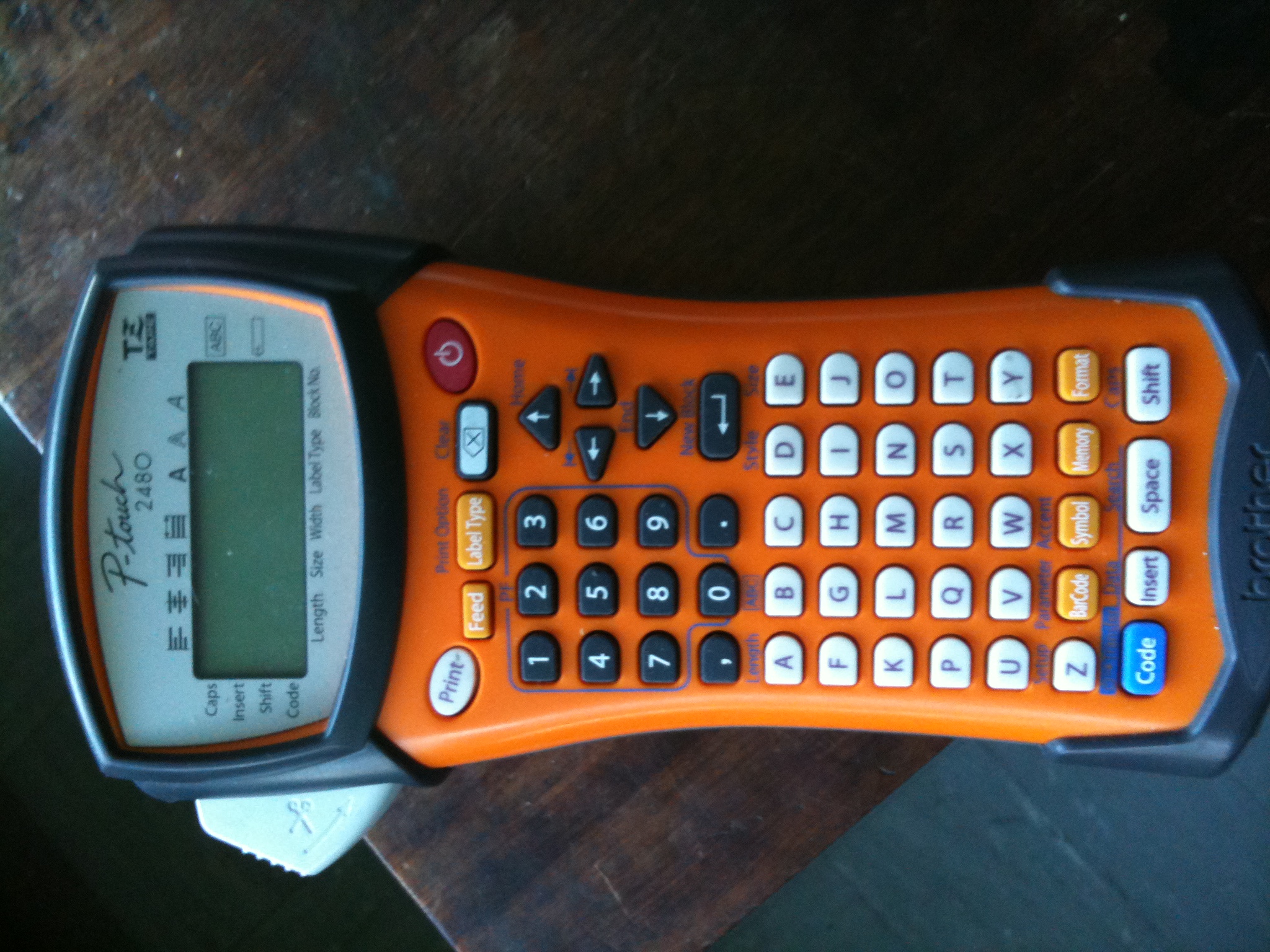
1. An electronic labeller.
Not cheap. But very, very necessary.
This model allows for different size tape and different font sizes.
It also has a wide range of characters, including mathematical symbols.

2. Trays
More specifically, gratnell trays.
Durable, stackable, availabe in a range of sizes and colours.


3. Sweet boxes
More specifically haribo boxes. For storing all the small bits; everything from protractors to spatulas to  test-tubes.
They also act as little basins of water if need be. And they’re all completely free.