Resources for teaching Magnetism

This week with Form 6 it was Magnetic Fields.

One of the concepts I try to emphasise is that this is a 3-dimensional phenomena, as opposed to the 2-dimensional pattern that you get from sprinkling iron filings on a page.

Some of these help:

I got the ferrofluid from teachersource.com

For bonus points, on this next video can you guess why the clips are only standing up sometimes as opposed to all the time?

Magnetic Movie from Semiconductor on Vimeo.

And no discussion on Magnetism could be complete without a mention of the man who gives his name to the unit of Magnetic Field Density; the Tesla.
http://theoatmeal.com/comics/tesla

All these links are available from the Magnetism page of the website.

Some fun teaching Vectors

This week we were looking at Vectors. It can become a bit tedious so no harm to introduce the topic with a fun puzzler.
So you’re travelling in a pick-up at 30 mph and you fire your beer bottle backwards at exactly the same speed. What happens?
Well Naturally Mythbusters had to find out.

The original was Japanese:

And finally, for a few minutes fun at the end of the class, what happens when the second largest ship in the US Navy is on patrol in the Irish Sea and encounters . . .

For teaching addition of Vectors the pHet site is very useful

These links can all be accessed through the Vectors page of the website.

Getting instant feedback from students

This was created as a skit, but I really like the way it illustrates the sense of frustration many students must have while sitting in our classrooms, knowing that they are never going to ‘get’ our subject. It brings back unpleasant memories for me of classes in I was in a student in, in both secondary school and college. I can still remember my maths teacher shouting at me when he realised that I didn’t understand anything he had covered for the previous two classes. By the time I realised I was lost it seemed too far in to acknowledge it, so I just sat there hoping it would all click into place. It never did.

How likely is it that a well-meaning student in your class will put their hand up and admit that they are lost?

One technique which works from time to time is to issue students with ‘traffic-light’ cards. These consist of a set of three cards; red, orange and green. If the student is following everything you are saying then they put out the green one, if they are a little unsure they put out the orange one, and if they’re lost they leave out the red one.

If you find yourself looking out at a sea of red then it’s time to re-evaluate your lesson.

It requires confidence on your part, and a little bit of courage. It also assumes the students will take it seriously, but they usually have more sense than we give them credit for.

It’s ok to say “I don’t know”

Josh has just come into Fifth Year. I don’t teach him this year but have had a lot of contact with him over the years; he is enthusiasm personified.

His latest query relates to that little matter of The Big Bang. What, he asked me recently, was there before The Big Bang?
I thought about it briefly, wondered if I should mention Space-Time, singularities, multiple-universes and such, then realised that I should just be honest with him.

“Josh”, I replied, “I have absolutely no idea”.

“But you’re a Physics teacher – you’re supposed to know about these things”.

“That’s as may be”, I replied, “but it doesn’t change the fact that I still have absolutely no idea what was out there before The Big Bang. Or, for that matter, what ‘out there’ even means”.

Josh obviously wasn’t too impressed with this answer. Next time I saw him I asked him if he was still annoyed at me.

“Not annoyed”, he said, “just puzzled. “I asked four other people the same question and they all tried to explain it to me but I didn’t know even know what they were saying, so I just pretended that I was able to understand so they wouldn’t feel bad. I just don’t know why you are the only one who won’t tell me the answer.”

Though Josh doesn’t realise it, his comment was rather profound. It is depressing that we as teachers promote this myth that we have all the answers to their questions.
And, on a more philosophical level, that Science should have  all the answers to life’s questions.

The late George Carlin called the entire universe ‘The Big Electron’. It’s as good a description as any, particularly when you include Richard Feynman’s description of the electron:

‘The electron is a theory we use; it is so useful in understanding the way nature works that we can almost call it real.’

Here is Carlin with another of my favourite comedians: Bill Hicks.

When getting an A is not enough . . .

We have a system in our school where about five times a year teachers issue Effort Marks to students (this also goes out to their parents).

As part of that system we give students a mark from 1 – 4 which reflects their academic effort. If a student is getting an A in class tests then this is supposed to merit a 1, but personally I think the bar should be set a little higher. Lots of people get A’s; if I give them all 1’s then there isn’t any mark left for those who something above and beyond the normal call of duty.  Some students may not be happy with this, and some have asked me what they need to do to get that elusive 1. So here’s my answer: Enter a competition. It can be Science, Maths, or anything else with a Science/Maths theme. Maths Week is just over which can only mean that Science Week is lurking somewhere around the corner.

Now everybody knows that I think ScienceWeek is a depressing indictment on our profession. Why should we need a week-long series of activities to convince students and the public that Science is interesting? Why is every week not ScienceWeek in our schools and classrooms? What does that say about us as teachers, and in particular about the rediculous syllabus we are asked to implement? Bring on the JC reform, that’s what I say. Not to mention that anything the teacher unions give out about must be good for students.
But I digress . . .

Enter a competition. Check out some of the following sites:
http://www.mathsweek.ie/
http://www.scienceweek.ie/

http://www.scifest.ie/
http://www.btyoungscientist.ie/
http://www.pumped.ie/ (thanks to frogblog.ie for highlighting this one)

Or have a go at this one

Maths Eyes and Geogebra Competitions

Fun for all ages and  Digital Cameras to be won in a  fantastic competitions!

For Maths Week 2012 in collaboration with the Institute of Technology Tallaght and the Maths Eyes initiative we are offering an  new exciting activity for all ages. Entrants explore the mathematics of real life using a photograph taken in  their local area and the free mathematical software GeoGebra. See more at http://www.haveyougotmathseyes.com/explore-how-to-use-geogebra/

The categories for the competitions are 7 years or under, 11 years or under ,14 years or under,18 years or under , Adult Education (Open to all those currently participating in an adult education course), Family/Community Group (collaboration between family members or collaboration between members of a community group)

The closing date for entries is this Friday 27th October. The basic idea is that students take a photo of something in their locality, import it into GeoGebra and highlight some aspect of the underlying mathematics ( see eg above). There are screencasts on the website for the competition showing how to import photos  etc as well as practice photos and prepared Geogebra files with photos already inserted, so even if people don’t want to enter the competition it might be useful as a learning activity to point the students at etc.

There’s that word again . . . WONDER

Students today are often immersed in an environment where what they learn is subjects that have truth and beauty embedded in them but the way they’re taught is compartmentalised and it’s drawn down to the point where the truth and beauty are not always evident.

It’s almost like that old recipe for chicken soup where you boil the chicken until the flavour is just . . . gone.

I have this video numerous times but it was only when I watched its creator David Bolinsky talk about it on TED that I heard that powerful word again: Wonder.

Here’s another take on it, this time from Simon Jenkins in the Guardian

I devour popular science, finding its history and its wonder a constant delight. . . . It is a mystery how so many science teachers can be so bad at their jobs that most children of my acquaintance cannot wait to get shot of the subject. I am tempted to conclude that maths and science teachers want only clones of themselves, like monks in a Roman Catholic seminary

Or how about George Monbiot:

We are deprived by our stupid schooling system of most of the wonders of the world, of the skills and knowledge required to navigate it, above all of the ability to understand each other. Our narrow, antiquated education is forcing us apart like the characters in a Francis Bacon painting, each locked in our boxes, unable to communicate.

This one is mine – maybe we should form our own society!

We educators take this incredibly exotic jungle of knowledge called Science and distil it until all the wonder has been removed and we are left with nothing but a heap of dry shavings. We then pour this drivel into our syllabus and textbooks and make our students learn it off by heart so that it can all get vomited back up come exam time.
And then we wonder why so many young people don’t like science.

It’s really such a shame that the wonder of Science only seems to be spoken about by artists, poets and writers. Why do scientists (and science teachers, and in particular those who are responsible for drafting the science syllabi) hide from it so much?

Would they not accept that by acknowledging the Wonder that lies at the heart of the subject we might actually engage the students a little more? Maybe it goes right back to the origins of Science.  Adam Smith once wrote that “Science is the great antidote to the poison of enthusiasm and superstition” and the philosophy behind the world’s first scientific society was to discover knowledge, not by force of argument or flowery speech, but rather as a result of cold, objective facts (hence the gradual removal of the use of the first person singular when describing experiments and the move towards the more impersonal ‘the experiment was set up as seen in the diagram’).

What a disservice we do to our students.

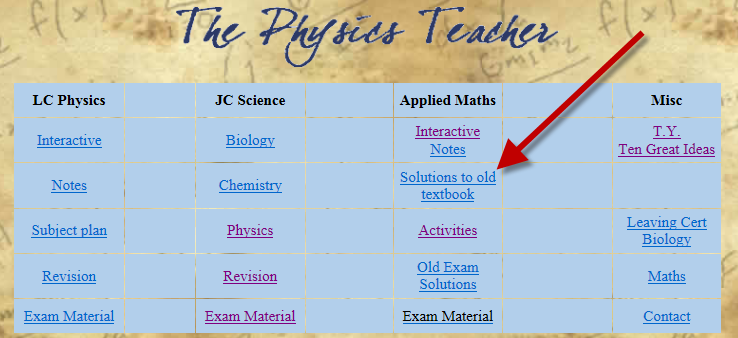
Solutions to (old edition) of Fundamental Applied Maths

I have had three students work on this for a week or so, scanning in page after page after page during their lunchtime breaks.

So a big thank you to Eoin and the two Jacks for giving up their spare time to help Applied Maths teachers and students all over the country.

The document is available from the homepage here and I have received permission from the author Oliver Murphy.

I can’t image that the publishers have any issue with my making solutions available to a textbook that is no longer in print, but if they do I will of course remove the offending article.

Apparently the solutions to the new edition of the textbook are available from folens.ie if you are using that book.

Personally I don’t use any textbook. The notes that I use  contain questions on each topic going right back to the beginning – 40 years ago. I also issue a copy of the marking schemes/worked solutions for each question and we pretty much get stuck into exam questions right from the get-go. All of my resources are freely available from the website above.

At the moment most topics list the questions chronologically; I am in the process of re-setting these to that the questions are graded in relation to difficulty within each type of question. That may take a while.

An appreciation . . .

Every now and again I get a letter like the following, which makes all the time and effort put in over the years worthwhile. The letter has been edited slightly to protect the innocent.

(I also just received my first donation on the website – thanks Lisa – so I’m now up to a grand total of €50.  Actually my sister also donated €1 over a year ago, just to confirm that the link was actually working, but I’ve been meaning to give that back).

Dear Sir,

My name is ______________.  I am a student who undertook Physics for Leaving Cert 2 years ago.
My physics teacher . . .
I was under the impression that Physics would be an easy subject . . . and that it required no work. How very wrong I was.

When I saw notes over the summer of 5th year belonging to my friends in other schools I saw how much work I had to do. Luckily I stumbled across your website and from then on things looked brighter. I suggested the site to my class mates and we immediately started to ‘get the hang’ of Physics.

I scored an A2 in Physics and surpassed my expectations. Of a class of 18 there were 3 A grade, 12 B grades 2 C grades and an A at ordinary level, all thanks to you and your marvelous notes.

I’ve gone on to study Biomedical Science. I still use the basic fundamentals of physics everyday, and I learned these fundamentals from you. 4 from the class went on to study Physics in the class, 6 went on to do Engineering, and 2 are studying music. The rest are in Mathematical Sciences and Veterinary.

On behalf of our class, I just wanted to thank you. We may never meet you in person, but you have made a huge impact on the direction of our education, simply by making what we were learning interesting. I cannot thank you enough for this.

My sincerest thanks and best wishes,

Teaching Magnetism

I started Magnetism with First Years today. They seem to be an enthusiastic bunch but let’s face it; if you can’t make Magnetism fun then you’re just a crap teacher. Anyway, after giving them a pair of magnets they were sent off to come up with as many unprompted observations as they could. It worked very well and some of their observations included the following:

(i)    Sometimes magnets attract each other, sometimes they repel.
(ii)    Magnets attract some materials but not others.
(iii)    The only materials that they were attracted to magnets were metals.
(iv)    They were attracted to some metals but not others.
(v)    It was not possible to distinguish why it was attracted to these particular metals.
(vi)    The metals seem to be more attracted to the poles than to the middle.
(vii)    When one nail was hanging at the end, it in turn became a magnet and attracted other nails.
(viii)    When the first nail was removed from the magnet, the second nail quickly lost its magnetism.

On the basis of these observations they were given the following puzzler for bonus marks homework.

Given only a bar-magnet and another similar-looking non magnetic metal, how could you tell which one was magnetic?

One more time: Why is so hard to make school Science engaging?

Dublin City of Science 2012 will host a 10 day ‘Science in the City’  festival from 6 – 15 July as part of the ESOF 2012 science in the city programme. The  Festival will consist of over 60 events and unites a community of cultural institutions, organisations and individuals who are passionate about showcasing the best of science, arts and culture in Ireland. The innovative programme of science themed events across Dublin consists of photographic and art exhibitions, several theatre pieces, film festivals, tours, trails and treasure hunts, science buskers, large-scale interactive installations, experiments, public talks, debates and workshops.

Taken from their website http://www.dublinscience2012.ie/

If you’ve got a son or daughter doing Science in secondary school in Ireland (or if, indeed, you are that student) keep an eye on the list of impressive activities that will be in the news over the coming few weeks. And then ask yourself why so very little of these wonderful and engaging activities are on the school syllabus. And then ask why not?

Why is the dull-as-dishwater  image of Science that we present in school (which in turn is a reflection of the syllabus) always at odds with the fascinating picture of Science that seems to be coming from everywhere else?
Why do we always have to look for ways to spruce up the syllabus?

Why is there no Astronomy/Cosmology at Junior or Senior cycle?

Why is the word ‘Evolution’ not even mentioned at Junior Cert level (it gets little more than lip-service at Leaving Cert level)?

Why is there nothing on Over-population or Obesity and almost nothing on the single greatest issue of our time – Global Warming?

Why can’t there be options to develop the interdisciplinary nature of Science – with Art, History, Geography or Religion to name just a few.
There are actually some quite engaging Science topics on the Religion syllabus (Evolution, Cosmology (including the Big Bang), Overpopulation and Global Warming), but none of this is considered relevant for our Science students.

Why can we not tell Science as a story?

And the bit that I am always most baffled by; why do so many Science teachers attend public Science lectures and activities (either as part of a school activity or from a purely personal interest) and yet not voice any frustration at the school syllabus that must surely be letting both them and their students down?

Here’s what The Guardian’s Geroge Monbiot had to say about our schooling:

We are deprived by our stupid schooling system of most of the wonders of the world, of the skills and knowledge required to navigate it, above all of the ability to understand each other. Our narrow, antiquated education is forcing us apart like the characters in a Francis Bacon painting, each locked in our boxes, unable to communicate.

And this one is mine:

We educators take this incredibly exotic jungle of knowledge called Science and distil it until all the wonder has been removed and we are left with nothing but a heap of dry shavings. We then pour this drivel into our syllabus and textbooks and make our students learn it off by heart so that it can all get vomited back up come exam time.
And then we wonder why so many young people don’t like science.

There is the odd rumbling about this disgrace from teachers themselves; Humphrey Jones over at frogblog.ie provides us with a neverending supply of resources to remind us how incredible Science actually is, and his alter ego site at morestresslesssuccess.ie is where you’re likely to find his personal ramblings.

Apart from that?