What Hollywood actress said the following in a recent interview for GQ magazine?
I’m interested in elementary particles, any spare time I have, I bury my head in a physics textbook. The elements at the atomic and subatomic level make up everything. You, me, the buildings, our souls, our minds. I’m reading a lot about Einstein. I like theories. I want to understand string theory. I’m dying for someone to explain quarks to me!
Answer
Anne Hathaway.
What rock-star recently acknowledged that watching quantum physics videos on YouTube had affected her music?
Thanks to Physics World for those.
It reminds me of the beginning of the brilliant E = mc squared; A biography of the world’s most famous equation, written by David Bodanis, where the author describes his inspiration for writing the book:
A while ago I was reading an interview with the actress Cameron Diaz in a movie magazine. At the end the interviewer asked her if there was anything she wanted to know, and she said she’d like to know what E = mc squared really means. They both laughed, then Diaz mumbled that she’d meant it, and then the interview ended.
All the material required to make Leaving Cert Physics a fascinating subject already exists – all we have to do is bring it together.
Don’t hold your breath.
We are deprived by our stupid schooling system of most of the wonders of the world, of the skills and knowledge required to navigate it, above all of the ability to understand each other. Our narrow, antiquated education is forcing us apart like the characters in a Francis Bacon painting, each locked in our boxes, unable to communicate.
There’s that word again: wonder. Why does eveybody ignore this- surely it’s not that difficult to fix?
With all the media attention on NAMA these times it’s understandable that most of us missed this headline from RTE the other day (hat-tip to eagle-eyed Jude for bringing it to my attention).
The RTE article leads with the following:
Research suggests that almost 10% of second level schools have been forced to drop Physics as a subject offered to students.
The findings indicate that the decision is as a direct result of education cutbacks.
Not a happy statistic, but presumably many of these schools had less than ten students in the class, and it just wasn’t feasable to maintain this. So why don’t more students do physics? It’s a very complex issue but the problem is causing concern to authorities throughout the western world. I believe that one very important factor is the picture of physics which students get from the Junior Cert – if we don’t get this right then it’s going to create a poor impression when they go to choose their leaving cert subjects.
So what would I change in Junior Cert Physics? – stay tuned.
Researchers at CERN have this morning announced the discovery of the heaviest element yet known to science. The new element, Governmentium (symbol=Gv), has one neutron, 25 assistant neutrons, 88 deputy neutrons and 198 assistant deputy neutrons, giving it an atomic mass of 312.
These 312 particles are held together by forces called morons, which are surrounded by vast quantities of lepton-like particles called pillocks. Since Governmentium has no electrons, it is inert. However, it can be detected, because it impedes every reaction with which it comes into contact.
A tiny amount of Governmentium can cause a reaction that would normally take less than a second, to take from 4 days to 4 years to complete. Governmentium has a normal half-life of 2 to 6 years. It does not decay, but instead undergoes a reorganization in which a portion of the assistant neutrons and deputy neutrons exchange places.
In fact, Governmentium’s mass will actually increase over time, since each reorganization will cause more morons to become neutrons, forming isodopes. This characteristic of moron promotion leads some scientists to believe that Governmentium is formed whenever morons reach a critical concentration. This hypothetical quantity is referred to as a critical morass. When catalysed with money, Governmentium becomes Administratium (symbol=Ad), an element that radiates just as much energy as Governmentium, since it has half as many pillocks but twice as many morons.
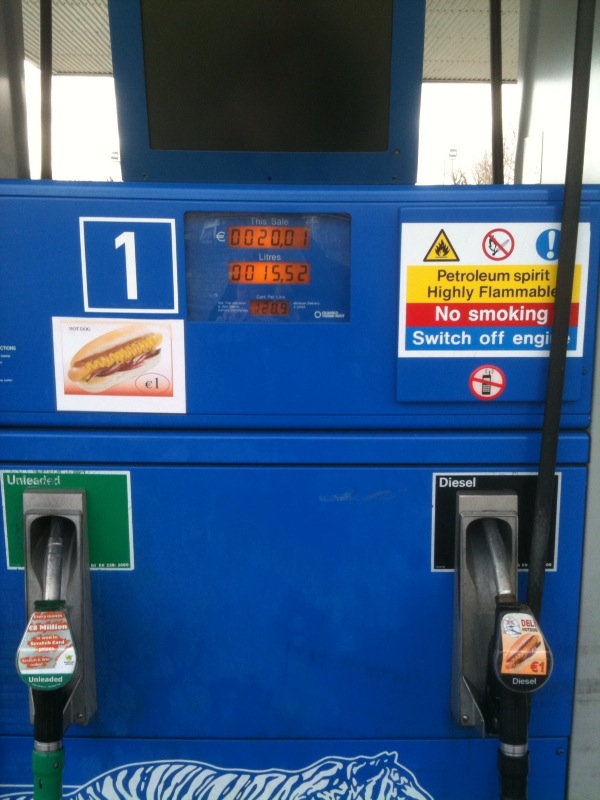
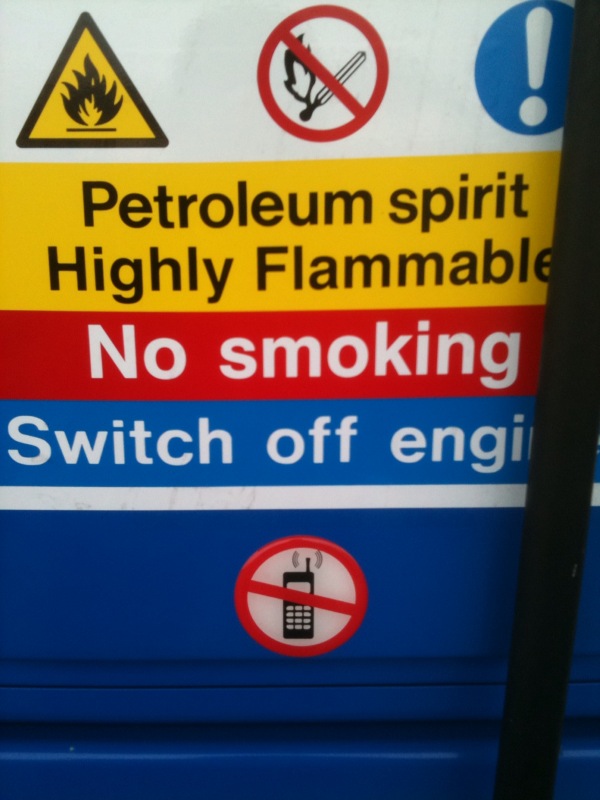
This sign now seems to be appearing regularly in petrol stations across the country. Presumably it’s because the owners are afraid that the mobile can somehow cause a spark, even though there is not the slightest bit of evidence that this can happen. Maybe it’s related to the demonstration involving mobile phones cooking pop-corn. We seem to be approaching the day when it’s not even Wikipedia we have to worry about as the source of all knowledge, but YouTube.
For the record, there is also no possibility that mobiles can cook popcorn, so yes, some of those videos may just be hoaxes.
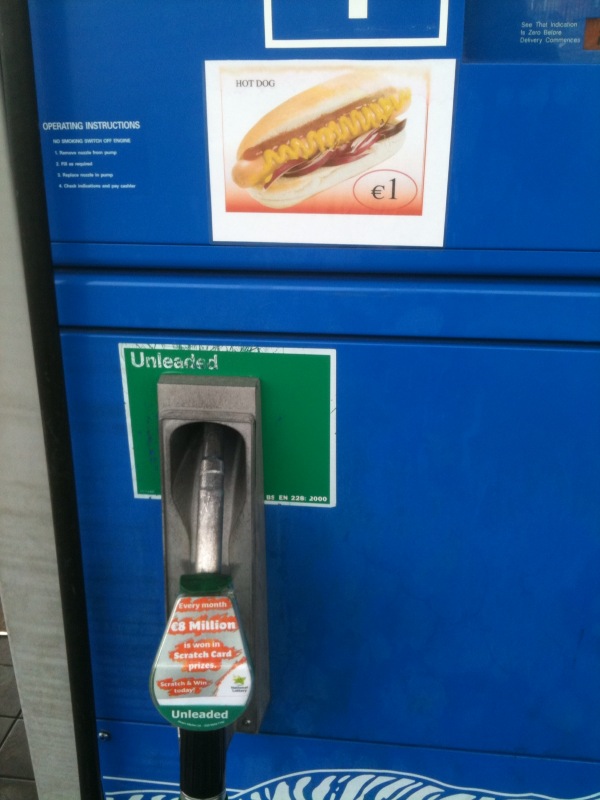
There does seem to be something not quite right about banning the use of phones while on the same pump having a picture of a big juicy hot-dog – I guess the heart attack you get in a few years’ time can’t be attritubed back to the station.
Oh, and don’t rub your bum on the car seat either.
We educators take this incredibly exotic jungle of knowledge called science and distil it until all the wonder has been removed and we are left with nothing but a heap of dry shavings. We then pour this into our syllabus and textbooks and make our students learn it off by heart so that it can all get vomited back up come exam time.
And then we wonder why so many young people don’t like science.
I would like to attribute that to somebody famous, but I can’t, ‘cos it’s mine. Which brings me to my apology.
I would like to apologise to students of secondary-school science everywhere – past, present and future, for having to put you through this process.
I would like to apologise for being a little cog in this horrible machine.
I would like to apologise for doing so little to change this, or even to raise it as an issue before now.
In my own little way I will do what I can to repair some of the damage, and show what science is like when the wonder is put back in.
I devour popular science, finding its history and its wonder a constant delight. . . . It is a mystery how so many science teachers can be so bad at their jobs that most children of my acquaintance cannot wait to get shot of the subject. I am tempted to conclude that maths and science teachers want only clones of themselves, like monks in a Roman Catholic seminary.
I couldn’t agree more. It is a sense of wonder in the world around me that has drawn me into science, and yet wonder is the one thing that is sorely lacking from all text-books and school syllabii. And we as teachers are doing absolutely nothing about it. We should be ashamed of ourselves.
Listen to all the big-wigs tell us why we need more students doing science – it’s the economy, stupid. Yet ask any kid why they are fascinated with science and the economy is not likely to come top of their list of reasons. It’s that word again – wonder. So why are we afraid to tackle it at school level? And why does nobody talk about it?
Heaven preserve us from engineers, university professors and politicians getting their grubby mitts on another science syllabus. Not unless they can first demonstrate a proven track recond on rating wonder as highly as a kid does. Not that we teachers have much to boast about in that regard either. It’s as though we try to hide our sense of wonder because somehow it doesn’t seem appropriate. Is it because we teachers like to give the impression that we have all the answers and therefore there should be nothing to fill us with wonder. I honestly don’t know. And I’m not even sure what I can do about it.
But I guess a good aul’ rant wouldn’t be a bad place to start.
Feynman, in this regard as in so many others, remains an inspiration.
The Royal Society will feature regularly in the news this year as it celebrates its 350th birthday.
Cambridge University astrophysicist Martin Rees is president of the Royal Society, so it was fascinating to watch him explain in an exclusive video interview why President Obama was right to cancel manned US missions to the Moon.
Wonder what Gil Scott-Heron would have made of it.
I reckon that if we really wanted to know what other life-forms exist ‘out there’ we might first spend a little more time checking out what is here and perhaps be a little more hesitant in destroying so many unexplored habitats on Earth. Not to mention spending a little more time and money on investigating our oceans.
Boyle: An’, as it blowed an’ blowed, I ofen looked up at the sky an’ assed meself the question — what is the stars, what is the stars?
…
Joxer: Ah, that’s the question, that’s the question — what is the stars?
Boyle: An’ then, I’d have another look, an’ I’d ass meself — what is the moon?
Joxer: Ah, that’s the question — what is the moon, what is the moon?
“Juno and the Paycock”, Seán O’Casey (1924)
From pretty much the time a baby can focus on the lights overhead he will notice the stars in the sky and wonder about them. Twinkle Twinkle Little Star has lasted through the years partly because it resonates with an innate curiosity in all of us to find out exactly what is up there. So you would think something about astronomy or better still cosmology would be on either the Junior Cert Science syllabus or the Leaving Cert Physics syllabus (or here’s a mad idea – why not both?). Not only is it not on either, but in the draft of the new Physics syllabus it doesn’t even get a mention.
Last year at a physics-teachers’ convention we were told that the draft could not be altered significantly and that therefore there would be no mention of stars, galaxies, the Big Bang, or indeed any reference to any of the incredibly exotic objects out there. There would, of course, be a consultation process but this seems to allow for no more than tinkering around the edges. Which begs the question why could we not have been consulted to begin with? Are we not to be trusted?
Presumably it’s still considered much more important to be able to measure the density of a stone than it is to explain the origin of the universe (interestingly you will find the Big Bang mentioned in the Religion syllabus).
I suppose even if these topics did get mentioned we would somehow manage to distil the wonder out of them like we do pretty much everything else on the syllabus.
Did you know that there are objects in the sky which are about the size of the Earth but which have the mass of the Sun, and which can spin almost 1,000 times a second? Remember our Earth takes 24 hours to do one revolution and yet these guys can spin one thousand times a second! Mad I tell you. Oh, and they were discovered by an Irish woman (they are called pulsars; check out this cool video on YouTube)
So what should students learn about the heavens? As always, put away the textbooks and look to our colleagues across the so-called ‘two cultures’ divide.
You want to know about galaxies? – sit up straight and listen to Monty Python.
Or how did it all begin? – Try The Barenaked Ladies.
Maybe if we want to attract students back into science we could do worse than start here.
Barenaked Ladies: It all started with the big bang


 Think for Yourself