Physics

When is a kilogram not a kilogram?

Many physics students will be familiar with the fact that the prototype kilogram is kept in a high-security vault in Paris. What I didn’t realise was that the mass of this specimen is changing, albeit very slightly.

So here’s the question; if this is the one and only true version of the kilogram, and it loses mass, doesn’t it still stay a kilogram?

And doesn’t that mean that other copies, which would have been correct originally, are now wrong?
(I think in fact that they may all be losing mass slightly.)

Something very unscientific about all this . . ., no wonder physicists are embarassed about it.

Seems a bit like when kids make up the rules of a game, and when it turns out that these don’t suit the leader of the gang, he just changes them.

Which seems as good an excuse as I am likely to get to show Eddie Izzard – Do you have a flag?


More youtube and some Flickr

Decided it was time to see what I could do with Flickr, so I spent the day taking photos of Junior Cert Science demo apparatus. The plan is that I will show this to students and they will have to name the demonstration. Hopefully it will help the second-years revise for Summer exams. It must be rather daunting to have to go from a year of short class tests, to a set of formal exams which require knowledge  taken in over the whole year.

Students can hopefully access this themselves if they wish, although I may  print it off for those who don’t have the facilities.

Bloody nice spectrum though innit?

Thanks Conor!

Of course there’s still the bread ‘n butter leaving cert material:


The Photoelectric Effect

I have been trying to get this to work for years, without success. And then recently I tried it again and lo and behold it worked like a dream!
Part of the problem was that if the day was even slightly humid the gold leaf electroscope wouldn’t hold its charge.
Secondly it had to be charged negatively, and I was never sure if I was charging it positively or negatively.
Thirdly I didn’t realise that I had to sandpaper the zinc in advance to remove the oxide layer.
Fourtly I don’t keep a list of questions related to demonstrations which I can’t get to work, so I only remember that there is a problem when I go to teach it each year, instead of asking an expert.

And I apologise for stating that this is “the most important least impressive experiment in the history of science”. It is actually rather impressive.
If I do say so myself.

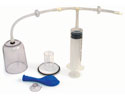
Microscale Vacuum Apparatus

microscale-science

This went down well at the ISTA conference in Letterkenny at the weekend where I was demonstrating as part of the Science on Stage team and I promised people I would let them know where I got it, so here it is:
teachersource.com

There is a lot more where this came from. I posted a brief note on the site recently , so browse the entire site. Remember the dollar has rarely been this low.

I will stick a video of the kit in action on youtube sometime this weekend (hopefully).

Chernobyl: the legacy

348910187_58dea72f81_m.jpg

Photo from Jeremy Nicholl on flickr

I have mentioned this before, but it’s worth throwing it up again (and again)

Given the low radiation doses received by most people exposed to the Chernobyl accident, no effects on fertility, numbers of stillbirths, adverse pregnancy outcomes or delivery complications have been demonstrated nor are there expected to be any. A modest but steady increase in reported congenital malformations in both contaminated and uncontaminated areas of Belarus appears related to improved reporting and not to radiation exposure

Source: World Health Organisation

It is a similar story for the survivors of the Hirishimo and Nagaski nuclear explosions.

This is always greeted with (i) disbelief, (ii) scepticism or (iii) amazement (at best) by my senior students.

I guess it’s very to argue with our gut feeling. But this is ultimately why we have this thing called SCIENCE, even if it is warts and all.

Fun with soda cans

I did a series of demonstrations yesterday involving soda cans and stuck the video of it on youtube.

I wanted it to be just one video but it went well over ten minutes (15 to be precise) so I had to split it in two.
It was fun though.
One of the problems with this sort of thing is that students will either have seen everything before in lessons, or will probably have seen me prepare them, so sometimes they need a little encouragement when it comes to showing their appreciation 🙂

Today we did a fun class on microwaving anything we could get out hands on.
The simple lightbulb was by far the most impressive.
I’ll try it again after midterm and hopefully video it.

The Counter-Intuitive Nature of Physics

Okay, here’s the deal.

You’re in a car going forward at 100 km/hr. You’re finished with your (glass) bottle of lucozade and naturally you just want to get rid of it by throwing it out the window. But you’re not a complete muppet; you would prefer if the bottle didn’t actully break upon impact.

So in what direction and at what speed should you throw the bottle?

Hint: Scroll forward to 3 minutes 50 seconds of this cool, cool video (unfortunately this site doesn’t seem to accept video embedding from this site).

Now I know that videos are no substitution for the real thing, but I think in this instance we can make an exception.

Henry Reed: Naming of Parts

One of my favourite poems is Naming of Parts, by Henry Reed. It encapsulates so much of what is wrong with our education.

It is about an army instruction lesson on the parts of an army rifle, where the poet is half listening to the instructor, and half looking outside the window at the beautiful japonica flowers. For me some of the best lines are here:

And this
Is the upper sling swivel, whose use you will see
When you are given your slings. And this is the piling swivel,
Which in your case you have not got.

So many Physics concepts are interconnected and we often find that we teachers introduce one concept in terms of others which students have still not covered and are therefore not familiar with.

Of course the more obvious message is the contrast between the dry-as-dust lesson and the wonderful world outside.

It’s also nice to read the comments below the poem; different people take completely different messages from it. And of course there is no one ‘right’ answer or interpretation, in spite of the answers which (some of) my English teachers wanted me to learn off so many years ago.

Henry Reed and Frank Duncan reading “Naming of Parts” here

Film adaptation of poem here


Youtube – is it just me?

I have had access to youtube in my classroom since last September and it is by a country-mile the geatest ICT resource I have in my arsenal.

You could take away the Interactive Whiteboard, the dataloggers and the DVD player, but I would cry if I lost youtube.

The irony is that I bought a VHS-to-DVD converter last year and it has taken me a full year to convert all my library. At the time I had probably 75 programmes, many on the same VHS cassette, and I was excited at copying each program on to a seperate DVD for easy access.

The big advantage of DVD was that I could scroll straight through to whatever part of the program I wanted – no more rewinding and fast-forwarding. I was also considering putting everything from there onto a large external hard-drive, for even easier access. All of this would take an inordinate amount of time, but would at least encourage me to use the resource more, where previously I would use it sparingly because of the hassle.

I think that for many students a video of anything more than ten minutes would lose their attention.
Hence my fascination with youtube.

This resource is available to everyone, there doesn’t seem to be anything too dodgy on it, or at least if there is it isn’t thrown at you; you would have to go looking for it.

All clips are under ten minutes. My favourites are Quantum Physics clips, because this stuff is not on any leaving cert syllabus (except maybe Religion) and the comments themselves are often revealing.

I wish I had this resource when I was growing up. If nothing else it allows me to see there are so many people out there who are as fascinated by science as I am, and unlike text-books and teacher conferences these people are all only too happy to express their wonder. It really is inspiring.

There are also wondeful demonstrations which can I can incorporate into my own lessons, and the videos usually include all those small but vital bits which text-books and demonstration-books often omit.
I feel like crying when I realise this resource is blocked in most schools.

I have spent quite a while loading up my favourite clips onto the online favourite program delicious.

CESI (Coputer Education Society of Ireland) are having their conference next month so my homework over the next week is to put together ten top reasons for unblocking this site.

Or is it just me?

del.icio.us site tagged with my youtube links are here
CESI
 homepage