The Ideology that dare not speak its name

The January edition of Science Spin included a supplement on choosing science as a career. I was asked to contribute my thru’penny bit as a science teacher. Most of the other contributors included their opinion of what science is, but either I wasn’t asked or, more likely, my reply was too boring to print. So here’s what I should have written:

Science is many things, but the more I find out the more I believe that Science is a tool used to maintain the inequality that exists between the First and Third world. It is  an instrument used to develop the military technology which enforces this inequality, and which in turn is fed by the unequal distribution of the world’s resources.

One of its strengths lies in its refusal to acknowledge its role in this. Indeed the mere questioning of this can label the critic as an ‘outsider’ and consequently negate the message or its potential validity.

For an example of this  look no further than the  manner in which the role played by war has influenced so many developments in Science, and how this is conveniently ignored for the sake of a more sanitised and noble picture which is what you will find in your school science text-book.

Now why couldn’t I think of that at the time?

It’s also only fair to acknowledge that the article was both interesting and very well written by Marie-Catherine Mousseau. It described very well the wide spectrum of careers available for graduates in Science. The magazine itself is also very impressive. I genuinely hadn’t read it in years but its production is top quality and I will certainly be checking it out again. See for yourself if you get a chance. In all good bookshops, as they say.

Science Spin

BBC Horizon: What on Earth is wrong with gravity? Tuesday 29 Jan

This program looks intruiging; may have to ask if I can stay up late to watch it.

What on Earth is wrong with gravity?

From the website:
Tuesday 29th January 2008, 9pm, BBC Two

Particle physicist and ex D:Ream keyboard player Dr Brian Cox wants to know why the Universe is built the way it is. He believes the answers lie in the force of gravity. But Newton thought gravity was powered by God, and even Einstein failed to completely solve it. Heading out with his film crew on a road trip across the USA, Brian fires lasers at the moon in Texas, goes mad in the desert in Arizona, encounters the bending of space and time at a maximum security military base, tries to detect ripples in our reality in the swamps of Louisiana and searches for hidden dimensions just outside Chicago.”

Check out Brian Cox’s rather cool biog

Students’ blogs

I was talking recently about setting up a group blog for students doing Scifest 2008.

John Hegarty suggested Google Groups might be a good way to go, and also mentioned that Tom Kendall gives talks on blogging in schools and he suggests the following site as a platform to work on http://www.21classes.com/

Tom has set up two of these in his own school: http://msmccarthy.21classes.com/ and http://crazy.21classes.com/.

Mags Amond however has suggested another alternative, which she mentioned on the DICTAT forum

“Also, nearer home, TeachNet / Digital Hub people are piloting a space for Irish Second Level students called Project Blogger (building with WordPress). The TY science students in 15 schools are being introduced to it over these few weeks, so Blogs being what they are there hopefully should be something to see very soon.”

All of these are involved with CESI, which is holding its conference on Friday 8th and Saturday 9th February, so maybe I’ll delay things a little and hopefully talk to them there.

Links for Scifest Project

Hello Philippa and Georgina and Jo Jo and Sarah and to others who I can’t remember.

The following are the links I said I would post which are related to your projects:

Charging while walking:
http://www.sciencedaily.com/releases/2007/10/071019183459.htm
http://www.technovelgy.com/ct/Science-Fiction-News.asp?NewsNum=452
It’s worthwhile looking at how this motion produces electricity:

This one involves usual solar power
http://www.abc.net.au/science/news/stories/s1079991.htm

Potato battery
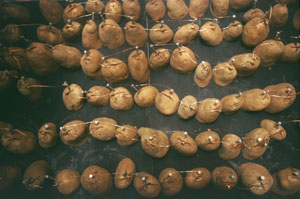
All you need for this one is 500 lb of potato

detail2-small.jpg
http://latteier.com/potato/
Not sure if this is possible either – but we can test!
http://uneasysilence.com/archive/2007/01/9276/

Onion and ipod
Looks like this may be a fake, but how can we tell . . .?

(not so) constructive comments:
http://www.fazed.net/view/?http://mailman.cloudnet.com/pipermail/compost/2003-December/011534.html
Heat from Manure
Not too much out there, but at least it seems to have been done before:
http://mailman.cloudnet.com/pipermail/compost/2003-December/011534.html

Good luck, and keep me informed.

Blog for Scifest?

Philippa and Georgina are in Second Year and have a wonderful idea for their Scifest competition. Philippa’s family have a number of horses and it has come to her attention that there is a large amount of heat generted in the manure heap. It may not be the cleanest job in the world but Philippa reckons she might be able to feed pipes through the manure heap and use it as a method to heat water.
They’re not so interested in whether or not this has commercial applications, merely in the science of how to get the most heat energy out.
I think it’s a wonderful idea – lots of variables to investigate- and has great potential.

We’re hoping to get quite a few students involved, and it occurred to me that this could be a really cool way to use blogs. Imagine if each group had their own blog, and could comment on each others’ projects. Serious potential for learning.

If anyone wants to advise on how best to approach this I would love to hear from you.

It would also bring them closer to how real science works. When I mentioned the possibility of blogging to the girls they were a little apprehensive of others stealing their ideas. Welcome to the world of science. Science has worked well in the past precisely because scientists were forced to publish their works in order to establish priority, yet they too had to be careful not to give away all their ideas.

One of the more well-known examples of this was the discovery of the structure of DNA by Crick and Watson. Watson wrote a wonderful book detailing his work at the time; this book – called The Double Helix – was highly controversial at the time because it turned out to be a warts-and-all approach, and many of the characters involved were not impressed with their portrayal.

Scifest 2008

The Double Helix on wikipedia

James Watson on TED.com

I need a Blog Go-To guy (or gal)

I try to engage with new technology, but I know I’m no computer whizz-kid. For instance I would like assistance in some of the following. I may well figure these out myself over time, but it would be a lot more painless if there was a go-to person.

  1. Knock off the ‘Moderate Comments’ option. I wouldn’t comment on a blog if I thought that the comment wouldn’t appear for 24 hours.
  2. Put up a ‘Subscribe by email’ option, or with a feedburner.
  3. Improve overall presentation

Hopefully this will be raised at the CESI conference next month.

Ideas and Thoughts

Came across this blog indirectly through Ewan McIntoshes edu.blog.com (see blogroll).

Some interesting recent posts include Lesson #1 – Share;

I get really frustrated when someone tells me about an outstanding teacher and I can’t find hide nor hair of their work online. What a waste. If they are as good as others say they are, why not share that with others?  They’ll tell me their kids made a great video, learned something great from an experiment or gave a great presentation but it means very little to me unless I can be part of it too. But even those who have the means and understanding aren’t sharing like they ought to. Some even offline don’t share much. Part of it is culture.

Couldn’t agree more. Peter O’Boyle is the most inspirational teacher I know (of). I know he is inspirational because his students tell me. I have never seen him in action. We are pretty close – I was honored to have him as my Best Man at my wedding. We often meet up for a few pints, and conversation covers all the usual bases. But I reckon on any given evening 75% of the time is related to our classes. To say he is passionate would be putting it mildly.

PO is going to retire sometime over the next few years, and all that knowledge and experience is going to retire with him. Unless we can somehow figure out how to record his classes. And persuade him that we should be allowed do so.

Scifest 2008

The Young Scientist competition is a wonderful idea and makes you wonder why our students can be so enthusiastic about this and yet so uninterested in studying Science in school. Could it perhaps be anything to do with us as teachers, what we teach or maybe how we teach it.

I have had some mixed feelings about the competition itself however. The decision as to whether you get accepted or not is based on a form which is filled out well ahead of time. I don’t know how the organisers could improve upon this (or maybe they have since I was last involved) but it means that a pretty basic project could get spruced up in the report such that the final presentation bears little resemblance to the report which was sent in.
Aaron Dormer was a student of mine from a few years back and spent a year putting together a large scale model plane and built his own aerodynamic testing station. I helped him with the report and was as positive as I could be about the whole thing, only to find that the project was not even considered worthy of presentation at the fair itself.
In fact I don’t think I have ever had a student or group enter.

That’s why I love Scifest

Put together by Sheila Porter it’s all on a much smaller scale, so almost all projects should be accepted for presentation. It may not have all the hoopla of Young Scientist, but it should get me back into this way of teaching.

Our (my) mode of teaching is very traditional and as a result very poor. I know about formative assesment, constructivism and all the other isms, but it’s just so very, very, very hard; and I mean VERY HARD to change my bad habits. Hopefully this will give me a suitable kick up the arse, and allow me to recognise that an old dog can actually learn new tricks.

I already have one group looking on the net for material, and I got to thinking; wouldn’t it be great if each group had their own blog and were encouraged to submit comments on their peers’ blogs?

Maybe I’m getting carried away!

SCIFEST 2008