Misconceptions about how students learn

Otherwise known as “How to study hard and still fail”

We’ve all come across the student who works hard in class and puts in the hours at night doing homework but never quite does well in class tests. Or perhaps it’s the student who does ok in class tests but then bombs the end-of-term exam and can’t understand why. The following may help in this regard.

Rate the following study techniques on a scale of 1 – 5 for effectiveness (5 being the most effective)

1.      Highlighting important material

2.      Writing out notes from a textbook or copying from teachers’ notes

3.      Reading over material covered in class

4.      Testing yourself

5.      Looking at mindmaps

6.      Creating mindmaps

7.      Making flashcards

8.      Testing yourself using flashcards

9.      Cramming the night before the exam

We’ll come back to these in a minute, but in the meantime here’s another task for you:

You have a Science test on Friday.
You have given yourself two hours to prepare for this over the course of the week, consisting of a half hour on Monday, Tuesday, Wednesday and Thursday night.
Which of the following four options is the most effective and which is the least (try it yourself before looking for the answer)?

Study  Study  Study  Study

Study  Study  Study  Test

Study  Study  Test     Test

Study  Test     Test     Test

The key to how the brain remembers information is retrieval. The more times it has to retrieve certain information, the more it ‘realises’ that this information must be important and therefore it stores it more securely (think of it as the brain’s hard-drive).

Care to re-evaluate your answers to the tasks above?

For study techniques the most effective option is testing yourself.
This is not only so that you can check your answers to see what you got wrong, but also (and this is the bit most people don’t realise) because the mere act of retrieving the information results in that information being stored more securely from then on.

What about highlighting important material?
You might as well be watching the Simpsons

What about reading over your notes (and your teacher may even have told you to do this for homework)?
You might as well be watching the Simpsons

Making flashcards?
You might as well be watching the Simpsons

Using flashcards?
Here you are testing yourself in a way that requires retrieval of information, so yes – very effective.

Mindmaps?
Interestingly, the research here shows that using mindmaps is relatively ineffective (no retrieval) but making them in the first place can be beneficial once you’re not merely copying it from elsewhere. If you have to think about how various concepts are related then the brain is constantly retrieving information, but once it’s done then it is of little further use. It may however help another student see the connections if he cannot make them for himself. So reading somebody else’s mindmaps may be a useful starting point on the journey of learning, but it’s not much more than that.

Writing out notes
Lots of students like to do this but unfortunately – you’ve guessed it; you might as well be watching the Simpsons.


I may be guilty of exaggerating slightly for effect and there may be contexts where some of these techniques are more useful than I’m suggesting here, but it’s only to emphasise the main point; students (and teachers) labour under some serious misconceptions when it comes to study.

So all study techniques are not equal.

And just because Moira is spending three hours up in her room every night ‘studying’ does not mean that this will automatically translate into good grades. It may also explain why her friend Jane, who only spends one hour a night studying, can outperform her when it comes to exams.

You have been warned.

A few points which we left dangling:

  • Why aren’t students aware of this?
  • To what extent are teachers aware of this, and if not why not?
  • How can we get students to change their study techniques?
  • What can teachers do to encourage students to change how they study at home?
  • What can teachers do in class to incorporate these ideas?
  • Why is it so hard for teachers to change their teaching styles to adapt to new ideas?

For another day.

Also for another day: how effective is cramming?

Finally, back to Friday’s Science test.
Most students go with option one.
Option 4 is the correct answer.

This is the second in a series of blogposts to accompany the new website betterteaching.ie. Over time, every webpage on the site will have an introductory post at the top. This post acts as an introduction to the Student Learning page. The various ideas above have been sourced from the posts on that page, in particular the work of Daniel Willingham is worth reading. It will take time to browse through all the information, so it may be worthwhile to bookmark the page and come back to it when free.

The following is one of a series of videos which discusses various study strategies, and in particular the importance of ‘deep processing’ when learning material or as the speaker says; how to study hard and still fail.
Does the world really need another education website?

index

Why create betterteaching.ie?

I am halfway through my teaching career (once outside interference is kept to a minimum) and when I look back on my time as a teacher I want to know that I was the best that I could be. I could use students’ exam results as the benchmark for this, or maybe rely on my own gut feeling, but that, tempting though it may be, would be highly questionable.

So I look for a more objective basis. How do I know I’m a good teacher? What are the qualities of a good teacher?  Is it even possible to be objective about such things?


The answer, it turns out, is none too flattering.


I believe there to be a good atmosphere in most of my classes, and yes the results are good and yes the students think I’m doing a stand-up job thank you very much. But if I take a look at what is recommended best practice elsewhere it turns out that I am ticking very few of the required boxes. In fact I am a perfect example of the type of teacher that fools just about everyone. The biggest black mark against my teaching is, ironically, that I teach too much. I spend too much time talking, too much time demonstrating and too much time entertaining. But there’s no time left over for standing to one side and allowing (facilitating) the students to learn from each other – a process which has been shown time and time again to be a much more effective learning technique.

You see with me the focus is on the teaching; I am the sage-on-stage and all eyes are on me at all times (or at least they should be). But the focus shouldn’t be on the teaching, it should be on the learning. And for that to happen effectively I need to move to one side, away from the spotlight, and act as a facilitator. But it is really, really difficult to change habits of a lifetime.

So where do I go to find best practice?  Short answer: Online.
Twitter has a poor reputation in many quarters because it is seen as little more than a time-wasting program where we can read the online diaries of the rich and famous.

But it has another side. Many of the best teachers, educators and educationalists are on Twitter and use it to share their ideas and resources. By following them I can become more effective at spotting what’s right and what’s wrong with my own teaching and do so at a pace that suits me without anybody else judging me. The same goes for blogs. And that’s mostly what this website is built around. Simple as.

So what are the issues I should be familiar with?

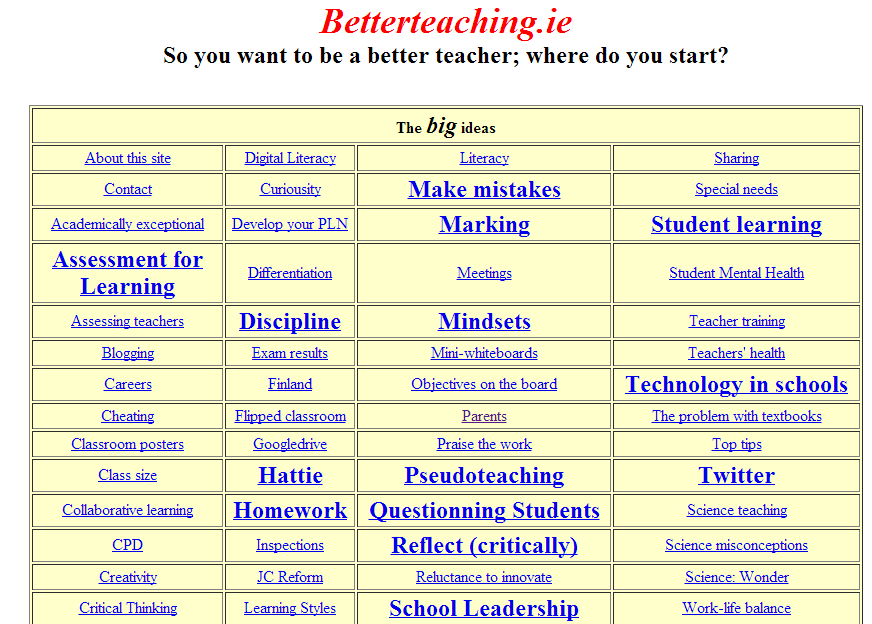
Well they’re all on the homepage, with the key ideas highlighted (see above).

There are a lot of other teachers out there who, like me, teach in a traditional manner; a format which probably hasn’t changed much from the time of Socrates. It’s not just that this is considered to be ineffective, it’s that much more productive alternatives have been developed, particular in the last couple of decades as a result of advances in neurobiology, cognitive science and psychology (yet another reason to love psychology). One of the key areas is in how we assess our students.
Anybody reading this blog or webpage is already familiar with the phrase ‘Assessment for Learning’, but there are a lot of us out there who aren’t.

Some other key ideas in education which merit having their own page above

  • The importance of reflecting on your work
  • How to engage in Continuous Professional Development (CPD)
  • How to develop a Personal Learning Network (PLN)
  • The importance of failure as a key step in the learning process
  • The idea that praising a student for excellent work can be counter-productive (we should be praising the effort put in instead)
  • The importance of a student’s (and a teacher’s) mindset in the classroom
  • How to use technology effectively
  • How to set homework effectively
  • How to engage with parents so that they become an integral part of the learning process
  • How to know that your students are learning (and that what they’re learning is what they’re supposed to be learning)
  • How to build a student’s resilience
  • How to question students effectively
  • What resources should I have in my classroom to help me?
  • What role does school leadership play in your teaching?

And what about the one issue many of us never talk about publicly, while privately it can be the cause of more stress than everything else put together: class discipline? Believing that to even speak about it is a sign of weakness means that it’s going to be a lot harder for us to find out how to improve it in our own classrooms. Here at least you can find out about the experiences of others and read about what worked (and just as importantly what didn’t work) for colleagues.

Or how about how students actually learn best? Do you know what the best practices are? Do your students? More importantly are you and your students aware of the study techniques that students spend most of their time on but which are quite ineffective?

I believe there is a ethical and indeed moral obligation on all of us to be the best we can be in whatever field we work in. For me this website represents  a step on that journey.

This is the first of a series of blogposts to accompany the website. Over time, every webpage on the site will have an introductory post at the top.
The design is deliberately minimalist. In a world where style rules over content this is my tilt at the windmill.

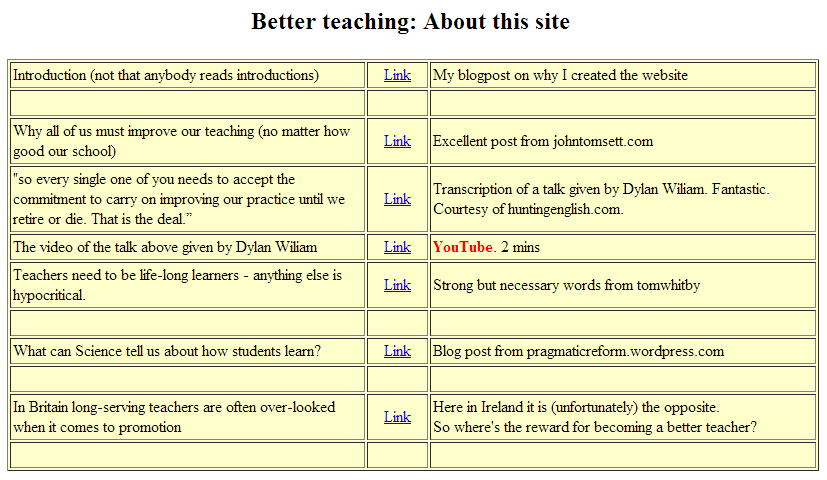
about this site

Let the adventure begin.

Just so you know, nobody knows what energy is

The following acts as my introduction to the students’ notes on the Energy chapter.

What is energy?

Nobody knows what energy actually is and by pretending otherwise we actually do you the student a disservice. Not only are we ignoring the wonder associated with the idea, we are also denying you the opportunity to engage with the concept at any level beyond the superficial.

Bottom line; nobody gets energy because there’s nothing to get. Energy is not tangible (it is ‘an indirectly observed quantity’); you can’t hold it in your hand, you can’t weigh it on an electronic balance, you can’t see it, touch it, smell it etc. Yet when the universe was first created there was a certain amount of this put in to the mix (actually now that I think about it the mix itself was energy (with perhaps just a little dash of time)), and it’s all still there today. Its form can change, but the energy itself can’t ever disappear – no sirree bob.

It could be argued that it is in fact merely an accountant’s trick which enables him to ensure that all actions balance.

Consider the following analogy which I like to use.

If a child asks you ‘what is money?’ you could take a few coins out of your pocket and show them to the child and say ‘this in money’. Now fast forward a couple of decades; all transactions are now done electronically/online and all coins and paper money are no longer legal tender. Now how do you explain what money is?

Well it’s a means of payment for goods and services, right? Somebody sells you an orange and you agree to transfer into their account a set amount of this ‘money’. And now that the shopkeeper has this money in his account he can use it to buy something else. So in effect money is just a transferrable IOU.

Now energy is a bit like this, but there is only a certain amount of IOU’s in the universe and this was set when the universe first came into being.

To complicate matters further, since the early part of the last century we now know (thank you Albert) that all matter (‘stuff’) is basically energy in another form.

Anyone still with me?


All right, let’s listen to Richard Feynman give his take on it.

There is a fact, or if you wish, a law governing all natural phenomena that are known to date. There is no known exception to this law – it is exact so far as we know. The law is called the conservation of energy. It states that there is a certain quantity, which we call “energy,” that does not change in the manifold changes that nature undergoes. That is a most abstract idea, because it is a mathematical principle; it says there is a numerical quantity which does not change when something happens . . . it is a strange fact that when we calculate some number and when we finish watching nature go through her tricks and calculate the number again, it is the same. It is important to realize that in physics today, we have no knowledge of what energy “is.” We do not have a picture that energy comes in little blobs of a definite amount. It is not that way. It . . . does not tell us the mechanism or the reason for the various formulas.

The Feynman Lectures on Physics Vol I, p 4-1

When Feynman wrote,
“It is important to realize that in physics today, we have no knowledge of what energy is,” he was recognizing that although we have expressions for various forms of energy (kinetic, heat, electrical, light, sound etc) we seem to have no idea of what the all-encompassing notion of “energy” is.

The various forms of energy (½mv2, mgh, ½kx2, qV,mcT, ½I2, ½CV2, etc.) are abstractions not directly observable.

2007 American Association of Physics Teachers

Now with that interesting bit out of the way, let’s go see what we need to know for the exam.

coe

CERN announces discovery of new element: Governmentium

Researchers at CERN have this morning announced the discovery of the heaviest element yet known to science. The new element, Governmentium (symbol=Gv), has one neutron, 25 assistant neutrons, 88 deputy neutrons and 198 assistant deputy neutrons, giving it an atomic mass of 312.


These 312 particles are held together by forces called morons, which are surrounded by vast quantities of lepton-like particles called pillocks. Since Governmentium has no electrons, it is inert. However, it can be detected, because it impedes every reaction with which it comes into contact.

A tiny amount of Governmentium can cause a reaction that would normally take less than a second, to take from 4 days to 4 years to complete. Governmentium has a normal half-life of 2 to 6 years. It does not decay, but instead undergoes a reorganization in which a portion of the assistant neutrons and deputy neutrons exchange places.

In fact, Governmentium’s mass will actually increase over time, since each reorganization will cause more morons to become neutrons, forming isodopes. This characteristic of moron promotion leads some scientists to believe that Governmentium is formed whenever morons reach a critical concentration. This hypothetical quantity is referred to as a critical morass. When catalysed with money, Governmentium becomes Administratium (symbol=Ad), an element that radiates just as much energy as Governmentium, since it has half as many pillocks but twice as many morons.

“Of all the parts of a school curriculum Religious Instruction is by far the most important . . .”

Rules for National Schools

Rule 68

“Of all the parts of a school curriculum Religious Instruction is by far the most important, as its subject-matter, God’s honour and service, includes the proper use of all man’s faculties, and affords the most powerful inducements to their proper use. Religious Instruction is, therefore, a fundamental part of the school course, and a religious spirit should inform and vivify the whole work of the school.

The teacher should constantly inculcate the practice of charity, justice, truth, purity, patience, temperance, obedience to lawful authority, and all the other moral virtues. In this way he will fulfil the primary duty of an educator, the moulding to perfect form of his pupils’ character, habituating them to observe, in their relations with God and with their neighbour, the laws which God, both directly through the dictates of natural reason and through Revelation, and indirectly through the ordinance of lawful authority, imposes on mankind.”

See the full set of rules here.
Apparently these rules are under review.

’nuff said

My contribution to Science Week – I thought I might teach some physics

At 40 mins long it’s not going to go viral anytime soon. It’s the middle 40 minutes of a double class but in it we managed to learn about some of the following:

The structure of the atom.

We, and everything around us, are mostly empty space.

We discovered that the appearance of  ‘solidness’ is an illusion – which lead to a  discussion about how light works.
We learned that there is a cultural aspect to what we see (and you definitely won’t find that in physics textbooks) and that Newton himself was subject to this and it resulted in him making a boo-boo that still goes uncorrected right up to today.

We discovered that electrons are constantly cascading down along everything we see in a seemingly never-ending avalanche, powered by energy from incoming light (so when this power source disappears, the electrons no longer have energy to jump up or fall back down, otherwise known as darkness).

We learned why things feel solid – all to do with the force of repulsion between electrons at the surface.

We developed a deeper understanding of Newton’s Third Law.

We discussed the fallacy of language – know the word for something (like gravity) and understanding what gravity actually is are two very different things, and shouldn’t be confused with each other.

We discovered that physics teachers don’t have all the answers, and should never pretend otherwise.

We were reminded that because almost none of the above is in the syllabus, the syllabus is a disgrace. It’s no wonder students don’t see the point of it.
There were 22 students in that class and the discussion could have gone on and on – I had to kick them out the door.  One can only imagine the conversations they must have had over the dinner table that evening.

If only all those who make such a fuss over Science Week could put a fraction of that effort into making the school syllabus a source of wonder and curiosity instead of what it is – a series of dull as dishwater facts which are to be merely learned off by heart.

Why does Science Week bug me so much?

What is it about Science Week that gets under my skin so much?

It seems to be the one week in the year where we are supposed to go out of our way to make science interesting; the corollary being that for the rest of the year we concentrate on ‘normal science’ which isn’t interesting. We go back to ‘the study’ and our drive for ‘good results’.

This idea is reinforced when we look at the various syllabii that are in play. There is nothing in the preamble or the main section of any of these about emphasing the wonder in the subject or indeed even encouraging a sense of curiousity – which is what Science Week is all about.
I have written about this before and penned the following few lines to sum up my frustration.

We educators take this incredibly exotic jungle of knowledge called Science and distil it until all the wonder has been removed and we are left with nothing but a heap of dry shavings. We then pour this drivel into our syllabus and textbooks and make our students learn it off by heart so that it can all get vomited back up come exam time.
And then we wonder why so many young people don’t like science.

How about if, when drawing up a new syllabus, we use WONDER as our central idea? It would probably mean that when teaching biology we would actually have to discuss evolution (the word doesn’t exist on the current junior cert syllabus – can you believe that?). It would mean having to teach about topics in cosmology – this currently doesn’t feature at either junior cert or leaving cert physics level, despite it being one of the main sources of interest to students of all ages, and also a prominent feature of every Science Week.
In fact in just about every topic at both JC and LC level the content could and should be build around instilling a sense of awe rather than consisting of a series of dry facts.
I am currently teaching The Electron to leaving cert physics students. In an earlier topic we proved that light was a wave by demonstrating interference of light waves. In this topic we prove that it is particle-like in nature by demonstrating the photoelectric effect. Both of these demonstrations need to be known for exam purposes and presumably most ‘good’ students learn them without thinking much about them. To read about these in either the textbooks or the syllabus you’d think that there was nothing of particular interest here when in fact these two contradictory phenomena are cornerstones in possibly the greatest movement in physics of all time: what is now known as quantum physics. Quite simply, you can’t have something which is both a particle (being in one specific place) and also a wave (being spread out) – yet that’s exactly what we find light to be. To quote Einstein “The more successful quantum physics gets, the sillier it looks”. But then if you’re reading this far you probably already know quite a bit about quantum physics and how utterly wonderful it all is. So you’ll know why I am baffled as to why all the fun has been ignored.

We could do the same for almost any topic on either the junior cert or the leaving cert course. But then that would be a bit radical. Best to leave all the boring stuff in and leave the fun stuff for Science Week. The word ‘wonder’ has most likely never featured in any science syllabus over the past four hundred years, any where in the world, so why change now?

What also bugs me is why so few other teachers seem to care about this. I know many of them introduce the wonder associated with the concepts as they teach it, but many others unfortunately don’t. And if we look at the number of students who drop Physics and Chemistry at the first opportunity it may be that the latter category of teacher represents the majority. What’s particularly puzzling is that if you go to any teacher conference they will usually have these ‘interesting lectures’ as part and parcel of the day, and no surprise for guessing that these are the best attended. So why don’t these same teachers make more noise about including interesting material on the formal syllabus? How can a biology teacher stand over a junior cert biology syllabus that doesn’t include the word ‘evolution’?

This is just the latest of my rants about the lack of wonder in Science education – for more see There’s that word again . . . WONDER

For a gentle introduction to wave/particle duality see the following:

Teachers: engage with parents – they’re on your side

Given that our job is to educate their sons and daughters, it is hard to fathom that formal communication is kept to one (or at most two) parent-teacher meetings over the course of the year. This can’t be right. Early in the new year I gather the email addresses of at least one parent of each student and contact the parents with a general welcome message. Usually it is no more than an introduction and an open offer to parents to contact me by email or text if they have a question about anything to do with my class, but particularly if they have a concern about their child coping in my class.
Later I let them know what I expect from students in relation to behaviour and progress in class, homework policy etc. I also let them know where they can access class notes, what to do if they are missing class for any extended period (see previous post on using timelines), how best to revise, and occasionally give advance notice of upcoming class tests.

Getting feedback from parents who let you know that their child has a particular passion for Science coming in to the school does serve to make you conscious that you have a role to live up to here, but that can’t be any bad thing. I once had a parent ask me if I was likely to inspire her child. I was a little taken aback and the initial response was ‘how dare she?’, but on reflection I thought it was actually a wonderful question, so I answered her as honestly as I could. “I don’t know”, I said, “but I’ll certainly try my best”.

The usefulness of the emails can vary from class to class and year to year, but one thing which doesn’t change is the parents’ appreciation of personal contact. This is most notable with the parents of first-year students, for whom this may be their first experience of secondary education since leaving it themselves. It’s not unusual to get feedback from a parent who claims this is the only communication they have ever had of this kind over their child’s entire primary and secondary education. To be asked to give their own feedback is both a novelty and an affirming experience for these parents who can all often feel that they are  outside the tent when it comes to their children’s education.

Now inviting feedback from parents (or from anyone else for that matter) can leave you a little exposed. I was recently taken to task by a parent for checking his daughter’s homework and, on noticing that she wasn’t able to do some questions, mentioned that I would do them on the board after I checked everybody else’s. By the time I got around to everybody else I had forgotten about this one girl’s issues and proceeded to begin the class proper. The dad informed me that both she and he had spent a large amount of time on these questions the previous night and he wasn’t too impressed that I never went back to explain them in detail. There were a number to points that I took from this.

  1. I probably do this more often than I realise.
  2. The daughter wasn’t surprised that I didn’t go back over the questions – she just assumed that if she couldn’t do the homework this was her problem. This just makes my behaviour so much more disappointing.
  3. While it wasn’t pleasant to hear this, it most definitely was something I needed to be pulled up on. The dad wasn’t being rude; I had told all parents that I welcomed their feedback and he was merely obliging.
  4. What was much more disquieting was the thought that I have probably been doing this for years and would never have changed if it wasn’t pointed out to me. I assume my homework is relatively straightforward but in hindsight this is very presumptuous of me and is something I need to be careful about in the future. While all the time keeping in mind that there is a large body of evidence out there which calls into question the effectiveness of any homework I set.

So for any teachers out there reading this who haven’t already done so, why not send out an email this week to the parents of just one of your classes, setting out to do no more than initiating contact and offering them your email address – what’s the worse that could possibly happen?

Keeping an open-access online diary of classwork for parents, students and teachers

This year for the first time I am trying to keep an online diary of what I do in every class.

It started as something I was going to do with the senior years, but has developed to the stage where I now update it for all years, from First Year to Sixth Year.

Anyone can access this; the links for the various pages can be accessed from the homepage of thephysicsteacher.ie website.

 timeline image

This is useful on many levels.

  • Students who are absent for one day or a number of days can find out what they are missing.
  • It acts as a guideline to new teachers in other schools on how much time to give a particular topic or concept.
  • I have just started the timelines for junior years; first years in particular benefit in that if they forget to take down their homework they can access it online (mind you I am only too aware that homework is not nearly as beneficial as we would like to believe, but for now it’s school policy and while I try to keep it to a minimum, it does still get issued).
  • It should also assist students with learning difficulties who may not have taken the homework down properly, although as I write this I realise I should really check this with those individual students before they leave the classroom.
  • It acts as a reminder to myself of what homework I set (I don’t keep a written record and never have).
  • It acts as a reminder to myself of where we finished last class (I don’t do class plans in advance and never have and it usually takes me close to the full year before I know my timetable off by heart).
  • It acts as a reminder to myself of tests which I have to give.
  • I share two of my classes with another teacher – we can both edit the document to update our progress. This also works for student teachers who come in to take one or two classes a week and need to know where the class is at on any given day.

But it goes beyond this.

I can record what worked well and what didn’t so that when I go to repeat the topic the following year I can avoid repeating the mistakes; this is more of an aspiration at the moment – I don’t necessarily do this so much anymore but I certainly did when I first started teaching and it was a very valuable activity.

Parents can use the document to review what was covered in class and to check what homework was given (I email all parents at the beginning of the school year to introduce myself and to encourage them to contact me for any reason).

I guess in one sense it’s similar to Edmodo, but I want it to be open access to students and teachers both inside and outside the school.

I plan next term to get one of the students to write this up; it will be interesting to see how their review of the class contrasts with mine.