My friend Dee Maguire reminded me recently of some very useful videos on teachers tv of physics teacher David Robinson in action. Some of these are also on youtube:
The magnetic gun is also referred to as a ‘Gaussian gun’.
We had a bit of fun puting a basic one together at the end of class the other day.
Other video clips of David demonstrating can be found here on teachers tv; the radioactivity clip is particularly impressive.
You can also enter his name into the youtube seachbox for other demonstrations.
Because I hate it. I mean really, really hate it. So much so that I haven’t corrected a (leaving-cert) copy in years. I justify this (to myself) on the basis that I spend more than enough time in the lab on technician duty. I’m generally in the lab by 7:15 and spend most breaks there also. It may be putting together apparatus for some experiment or trouble-shooting gammy equipment which was returned broken by a student (or teacher).
Anyway, point is, I don’t apologise for taking shortcuts when I can.
So here’s what I do.
I have put together a marking scheme for every Leaving Cert mandatory experiment report and get the students to correct each others’ reports based on this marking scheme. They can’t keep using the same student to correct their report, and their final mark for each report must be entered in a master sheet which I keep open on the front desk. They can argue with each other as much as they like over their marks – but each mark must be justified.
What’s more, I give this marking scheme to the students at the beginning of the year so they get to use this to help them write up the report as they go along.
Students tape or paste the appropriate marking scheme on to the same page as the experiment it refers to.
At the very least I want them to appreciate that it doesn’t matter how much they write; there is always some key information which must be included.
A labelled diagram including all essential apparatus (paying particular attention to how results are to be obtained).
A description of how values were obtained for each variable.
An explanation of what was changed to enable obtaining other sets of data.
How the results were manipulated to allow for interpretation.
Graphs, conclusion, sources of error etc.
I usually need to remind them that a report without results gets zero marks, because it’s not a report. it’s like a journalist giving a report of a match without including the result – pointless.
Every so often, after first forewarning the troops, I inspect their copies to ensure that they are actually writing up the reports. But they must have their copy open at the correct page – because I refuse to take up their copies. I also tell them that copies are to he handed up for inspection before each end-of-term report and are worth 10 % of final mark. This is a lie. I refuse to take up their copies (although when volunteer them I do store them for the students – I’m nice like that).
The irony is that this approach seems to tie in nicely with what the educationalists tell us is ‘Formative Assessment’ and encourages the student to take responsibility for their own learning.
Which is obviously why I do it. Ahem.
Update.
We had an inspection in (I think) 2010 and the inspector commented favorably on this method of student learning.
Which is obviously why I do it.
By the way, if printing these for your class make sure you use the ‘print two pages onto 1’ option to reduce photocopying and paper costs.
I put together a list of (124) possible Young Scientist projects for my second-year class. Most of them are taken from previous years and hopefully it will give them some ideas.
Closing date is October so you need to get cracking. You don’t need to have the project finished by then, but you will need to have a one-page description ready to send off. Remember only about half of the applications are accepted for presentation.
The good news is that we will be concentrating on this over the next two weeks, so no boring science textbooks.
I pushed this with fourth years before but got nothing but frustration for my troubles. So this year I was going to concentrate on second-years, but some of my fourth-years have actually come up with some very interesting ideas. Hold this page.
David Gallo is equally enthuasiastic and just as enthralling.
From the TED website:
David Gallo shows jaw-dropping footage of amazing sea creatures, including a color-shifting cuttlefish, a perfectly camouflaged octopus, and a Times Square’s worth of neon light displays from fish who live in the blackest depths of the ocean.
And this is a seperate, more recent presentation (13 minutes long).
From TED:
With vibrant video clips captured by submarines, David Gallo takes us to some of Earth’s darkest, most violent, toxic and beautiful habitats, the valleys and volcanic ridges of the oceans’ depths, where life is bizarre, resilient and shockingly abundant.
It is a really wonderful world out there, and sometimes I can’t help but feel so incredibly lucky to be living in a time where we get to see so much of it. Right before it all disappears.
I posted very few videos on youtube last year, and am determined to rectify that this year, and in particular to put up some clips of Junior Cert classes.
Here are a couple on spherical mirrors:
The mirrors in this next one were purchased from educationalinnovations for about €20. They have a larger, 22 inch version for $1,195. Just a little out of our budget.
Starting with four basic questions (that you may be surprised to find you can’t answer), Jonathan Drori looks at the gaps in our knowledge — and specifically, what we don’t know about science that we might think we do.
So goes the blurb for the one of the latest talks on TED. Drori asks four basic questions:
1. Where does the “stuff” in trees come from?
2. Can you light a torch bulb with a bulb, battery and a single piece of wire?
3. Why is it hotter in Summer than in Winter?
4. What is the shape of the planets’ orbits?
How many can you answer correctly?
Drori then refers to a couple of videos he was involved in producing a few years ago where graduates of MIT were recorded giving their answers to some of these questions, and surprise surprise, almost all were unable to answer any question correctly. There is a nice moment when one young woman, on finding that she is incapable of puting the electric circuit together, justifies her lack of knowledge by saying “I’m not an electrical engineer, I’m a mechanical engineer”.
Drori wasn’t able to use the clips in his presentation due to a technical hiccup, but I am assuming that these are the videos he is referring to. The first is entitled “Can we believe our eyes?”, while the second is “Lessons from thin air”.
I referred to these videos in a post last year, and mentioned that the answers given by graduates were very similar to those given by six year olds. What I didn’t realise is that, according to Drori, research shows that concepts likeMagnetism and Gravity are betterunderstood by children before they go to school than afterwards!
This is stunning, and a little difficult to believe. I would like to find out where he got his information here, but then again, just because it goes against common sense isn’t reason enough to disregard it.
Another question asked in the “Can we believe our eyes?” video goes something like this;
Imagine you are facing a mirror. If you want to see more of your body should you move towards the mirror, away from the mirror, or does it not make any difference?
The point being made here is that ‘hands-on’ experience is not necessarily very educational. They even received incorrect answers from the barbers who work with mirrors every day. It reminded me of the recent fascinating discovery that cattle and wild deer tend to align their bodies in a North-South direction when standing in a field (link). How could we not have noticed that before?
I guess if we are not directly interested in something (almost at an emotional level) then we are rather unlikely to notice or form a deep understanding of it, and the traditional teaching approach of simply repeating the class lesson is of little use in changing that.
I know myself that I learned bugger-all physics in six years of secondary school or four years of college. I did however learn more in one year of teaching Leaving Cert Physics than I did in all the others combined. This was obviously because I was no longer ‘learning’ to pass an exam, but rather I was learning to survive in a classroom where I knew I would be taking questions from students who were expecting nothing less than an A1 in their Leaving Cert. I had taught in a previous school but had spent too many lessons ‘winging it’ and getting caught out, so for me this was a fresh start and therefore there was certainly an emotional motivation.
Which is why, if I find out that my students know less about magnetism and gravity now than they did before I taught them, I may just have to find a cold, dark room and lock myself in it for a long time.
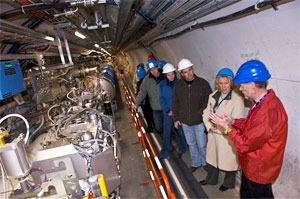
The Large Hardon Collider is due to be turned on this day next week (Wednesday, 10th of September), so it’s not a bad time to put together some useful resources to show to the troops to give them some idea of what it’s all about.
At just under 5 minutes, the Large Hadron Rap isn’t a bad place to start:
The ‘rappers’ mention dark energy and dark matter; comprising 96% of the universe between them, they can’t be directly measured, but their influence is immense. Find out more by watching Patricia Burchat speak at TED:
Want more? Try ‘Most of the Universe is Missing‘
Mary Mulvihill over at Science@Culture reminds us that BBCRadio 4 is devoting the entire day to the event. Watch Dara O’Briain, among others, give his rather unique take on the event. Not a big fan of homeopathy or Deepak Chopra is our Dara. He does appear to be a fan of Physics though; ‘wonder how he got on with Science in school? He strikes me as someone I’d have to keep on when it came to handing out chemicals!




 Think for Yourself