Our first podcast

I know I should be using podcasting more in my teaching, and part of the reason I stayed away from it is because I figure my voice is just not that interesting (not much of an excuse I know).
Anyway I figure students are much more interesting than I am, so I gave Maeve (Second Year) the dictaphone, and this is what she came up with. Not bad for a first attempt (I need to keep surnames out from now on).
See what you think. All constructive feedback welcome.
This particular clip may not be all that valuable from an educational point of view – it was just to give us all a feel of what could be done.
The nice thing about it is that now that we know we can do this, there is no end to what we can do with it.
I’d like to embed the player on this page, but havn’t been able to figure out that part yet.
Apparently you can subscribe to this in itunes (whatever that means).

Was the human species pre-ordained?

inourtime_fossils

I think this is one of the most significant questions that mankind has ever addressed, and yet I very rarely come across any reference to it.
Stephen Jay Gould is probably the scientist best associated with this. His well known metaphor runs as follows:

If you re-ran the tape of evolutionary history, an entirely different set of creatures would emerge. Man would not exist because the multitude of random changes that resulted in us would never be repeated exactly the same way.

Gould is by a long way my favourite science-writer (or was, until Bill Bryson dipped his big toe in the genre), and therefore I was always likely to agree with this view. The concept also appeals to be in that it reinforces our insignificance in the grand scheme of things.
So I was pleasantly surprised when I came across a program dealing with exactly this topic while browsing through the archives of In Our Time; a wonderful series where Melvyn Bragg discusses the big questions of civilisation (subscribe to his newsletter – it’s wonderful reading).

Who were the original proponents of the idea of a grand design? Were they deliberately setting out to find a scientific theory that could sit alongside religious faith? On the other hand, can the concept of contingency – or the randomness of evolution – be compatible with a belief in God?

Visit In Our Time to listen to the program (all quotes and image taken from that page). The discussion takes twenty minutes to get around to this topic, and the jury seems to go against Gould, but it’s good stuff nonetheless.
Take a few minutes to browse through the other programs (it’s not just Science; there’s also History, Culture, Religion and Philosophy) then save this page to your favourites and listen to other programs as you browse next time.

Of course this is much too interesting a question to appear on any Science syllabus.

“History repeats itself because no one was listening the first time.”

“That men do not learn very much from the lessons of history is the most important of all the lessons of history.”
Aldous Huxley

“If men could learn from history, what lessons it might teach us! But passion and party blind our eyes, and the light which experience gives us is a lantern on the stern which shines only on the waves behind.”
Samuel Taylor Coleridge

“What experience and history teach is this – that people and governments never have learned anything from history, or acted on principles deduced from it.”
G. W. F. Hegel

“Those who cannot learn from history are doomed to repeat it.”
George Santayana

“History repeats itself because no one was listening the first time.”
Anonymous

Taken from ageofthesage.org

The history of Easter Island is fascinating because it shows a civilisation slowly destroying its future in order to glorify the present. The people cut down their trees (which we now know were essential for their very survival) in order to carry stone for their famour statues, and must have continued to do this down to the last tree.
It would have make a nice moral story if the people had died off completely because they destroyed their key resource, but History is rarely this simple.
Nevertheless the moral still holds.

Watch The Mystery of Easter Island on youtube

The disappearance of the island’s trees seems to coincide with a decline of its civilization around the 17th and 18th century. Midden contents show a sudden drop in quantities of fish and bird bones as the islanders lost the means to construct fishing vessels and the birds lost their nesting sites. Soil erosion due to lack of trees is apparent in some places. Sediment samples document that up to half of the native plants had become extinct and that the vegetation of the island was drastically altered. Chickens and rats became leading items of diet and there are contested hints that cannibalism occurred, based on human remains associated with cooking sites, especially in caves.
From wikipedia


Fractals and Dinosaurs

Continuing with the space and dinosaurs theme:
I get my transition years to do a project on absolutely any topic on Science which interests them, preferably something off the beaten track (i.e. not in the textbooks). fortunately this doesn’t seem to be a drawback in the slightest. Almost no aspect of science which interests them is on any science syllabus.
Because I am as likely to be interested in their topic as they are, I suggested I would look for resources also and post them here.

In relation to fractals, the classic video is called The Colours of Infinity. The original DVD and accompanying book is available in the school library.
The problem for anyone doing a project on dinosaurs is sifting through the vast information that is out there. This clip is pitched at about the right level.

The Colours of Infinity:

When Dinosaurs ruled America

Colours from black and white? Say it ain’t so!

We had half a class the other day so we just played around with some equipment left lying about.

One such piece was a cardboard disc with black circles and shapes on a white background. If you spin it quickly you get to see coloured circles! It’s mad I tell you.

Only thing is, because it’s got to be a psychological effect it doesn’t get picked up on the camera.

Hates that.

Trainee teachers get a raw deal


doctor-patient1

Does a medical student get to work on a patient/diagnose a patient for the first time unsupervised?

Does a trainee mechanic get to work on the brakes of a car for the first time unsupervised?

So why is a trainee teacher who is on teacher practice in a classroom, usually unsupervised?

Because the main teacher has buggered off, that’s why.
Sooner or later the Department of Education will have to clamp down on this, and we as professional teachers will have to toe the line. Now some of us spend this time productively, while more of us use it to have an extended coffee break, or if we get lucky we can even leave the school early or arrive late in the morning.

In fact if we plan it out properly in advance we can even give ourselves the day off.

Point is, this shouldn’t happen. In a training hospital there is an understanding that the ‘master’ doctor (isn’t ‘master’ a horrible term – or am I just too PC?) assumes responsibility for the trainee; shows him (or her) the ropes, and gradually exposes the trainee to a greater level of responsibility. Why do we get away with not doing this?
Yes of course I am generalising, but does anybody even know to what extent? Do some schools have a policy on this?

The temptation is often to give the trainee teacher a transition-year class and the rationale may be publicly that it is unfair to an exam class to expose them to a new teacher, which certainly seems reasonable, but then a transition-year class is always going to be more difficult to motivate – and discipline (could this add to the attraction of ‘fobbing it off’ onto a hidip?). So if we are sticking a new teacher with this class, the onus should be on me as the main teacher to remain in the class at all times.

It does create a slightly artificial atmosphere, but what I have found is that most of the time the students quickly forget about the teacher at the back, and just get on with on it. If the trainee-teacher has problems controling the class this will soon become obvious, with or without another teacher at the back.

Isn’t there also an insurance issue with leaving an unqualified teacher to run a practical session in a lab?

This brings up a second issue.
Why are these trainee teachers teaching classes at all?
Wouldn’t they be better off observing as many teachers as possible to critique the different teaching styles? After all, they can be ‘blooded’ at any stage but chances are they will never again have the opportunity to sit in on a colleague’s classes. I’m arrogant enough to think that a new teacher could learn something from observing my teaching style; maybe it’s only how not to teach a class – but that’s still a valuable lesson that otherwise may never be learnt.
A colleague of mine is hoping to initiate a group of like-minded teachers who are prepared to let colleagues sit in on their classes, but purely from a timetable point of view it may prove unfeasible.

At least it’s certainly a step in the right direction.

It’s almost 40 years since we first put a man on the moon.
Is it possible to create a space/forum/platform for teachers to discuss these issues?
How would we respond?

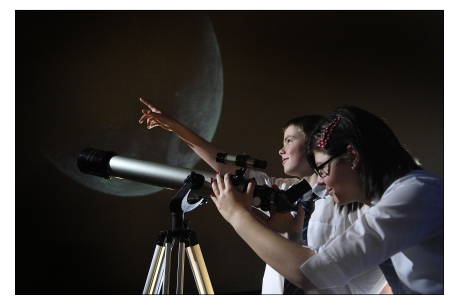
Free Telescopes for Schools – what a wonderful idea!

year_of_astronomy_2_thumbnail

A colleague reminded me recently that when you think about it, there are really only two concepts that fascinate young kids; Space and Dinosaurs.
Okay, so this is a gross generalisation, but with work with me here.

Somebody in England has cottoned on to the first part of this.

The Society for Popular Astronomy (SPA), Royal Astronomical Society (RAS) and Science and Technology Facilities Council (STFC) have teamed up to give free telescopes to 1000 secondary schools.

And in Ireland?
Don’t hold your breath.
But at least both of these topics are on the school syllabus right – especially seen as we seem to want to encourage more young un’s to take up Science?

Welllll . . . Umm . . . Ehhh . . .Hmmmm . . .

Too obvious I suppose.