This is never going to go viral like the LHC rap, but I thought it was pretty cool.
Both the history and the science are spot on, it’s just a pity that there’s a 40 second intro. Who has this amount of time to spare?
This is never going to go viral like the LHC rap, but I thought it was pretty cool.
Both the history and the science are spot on, it’s just a pity that there’s a 40 second intro. Who has this amount of time to spare?
We have Open Day coming up and I was considering using the bed of nails. It’s certainly impressive, but I think we may not have enough room or time on the day.
It’s pretty cool though. And the nice thing about it is that the more nails you have on it per unit area, the more dangerous it looks but the safer it actually is (from Pressure = Force / Area).
Then all you need to add is another bed on top, and on top of this a cavity block.
Then smash the block with a sledge-hammer (this to demonstrate the property of inertia).
Then add more beds!
My friend Dee Maguire reminded me recently of some very useful videos on teachers tv of physics teacher David Robinson in action. Some of these are also on youtube:
The magnetic gun is also referred to as a ‘Gaussian gun’.
We had a bit of fun puting a basic one together at the end of class the other day.


Other video clips of David demonstrating can be found here on teachers tv; the radioactivity clip is particularly impressive.
You can also enter his name into the youtube seachbox for other demonstrations.
Thanks Dee
I posted very few videos on youtube last year, and am determined to rectify that this year, and in particular to put up some clips of Junior Cert classes.
Here are a couple on spherical mirrors:
The mirrors in this next one were purchased from educationalinnovations for about €20. They have a larger, 22 inch version for $1,195. Just a little out of our budget.
Starting with four basic questions (that you may be surprised to find you can’t answer), Jonathan Drori looks at the gaps in our knowledge — and specifically, what we don’t know about science that we might think we do.
So goes the blurb for the one of the latest talks on TED. Drori asks four basic questions:
1. Where does the “stuff” in trees come from?
2. Can you light a torch bulb with a bulb, battery and a single piece of wire?
3. Why is it hotter in Summer than in Winter?
4. What is the shape of the planets’ orbits?
How many can you answer correctly?
Drori then refers to a couple of videos he was involved in producing a few years ago where graduates of MIT were recorded giving their answers to some of these questions, and surprise surprise, almost all were unable to answer any question correctly. There is a nice moment when one young woman, on finding that she is incapable of puting the electric circuit together, justifies her lack of knowledge by saying “I’m not an electrical engineer, I’m a mechanical engineer”.
Drori wasn’t able to use the clips in his presentation due to a technical hiccup, but I am assuming that these are the videos he is referring to. The first is entitled “Can we believe our eyes?”, while the second is “Lessons from thin air”.
I referred to these videos in a post last year, and mentioned that the answers given by graduates were very similar to those given by six year olds. What I didn’t realise is that, according to Drori, research shows that concepts like Magnetism and Gravity are better understood by children before they go to school than afterwards!
This is stunning, and a little difficult to believe. I would like to find out where he got his information here, but then again, just because it goes against common sense isn’t reason enough to disregard it.
Another question asked in the “Can we believe our eyes?” video goes something like this;
Imagine you are facing a mirror. If you want to see more of your body should you move towards the mirror, away from the mirror, or does it not make any difference?
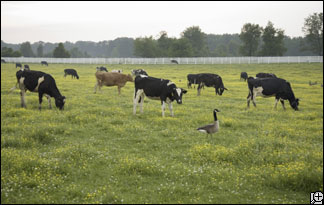
The point being made here is that ‘hands-on’ experience is not necessarily very educational. They even received incorrect answers from the barbers who work with mirrors every day. It reminded me of the recent fascinating discovery that cattle and wild deer tend to align their bodies in a North-South direction when standing in a field (link). How could we not have noticed that before?
I guess if we are not directly interested in something (almost at an emotional level) then we are rather unlikely to notice or form a deep understanding of it, and the traditional teaching approach of simply repeating the class lesson is of little use in changing that.
I know myself that I learned bugger-all physics in six years of secondary school or four years of college. I did however learn more in one year of teaching Leaving Cert Physics than I did in all the others combined. This was obviously because I was no longer ‘learning’ to pass an exam, but rather I was learning to survive in a classroom where I knew I would be taking questions from students who were expecting nothing less than an A1 in their Leaving Cert. I had taught in a previous school but had spent too many lessons ‘winging it’ and getting caught out, so for me this was a fresh start and therefore there was certainly an emotional motivation.
Which is why, if I find out that my students know less about magnetism and gravity now than they did before I taught them, I may just have to find a cold, dark room and lock myself in it for a long time.
2:28 in:
Sir Pedivere: What also floats in water?
Peasant 1: Very small rocks?
King Arthur: A duck.
Sir Pedivere: Exactly, so logically, if . . .?
Peasant 2: she weighs the same as a duck, she’s . . . make of wood.
Sir Pedivere: And therefore?
All: a witch!
It somehow seems all too familiar.
Tables charting the chemical elements have been around since the 19th century – but this modern version has a short video about each one.
In the short time since launching this site, our videos have been watched more than 1.8 million times.
But we’re not finished yet. We’ve started updating all the videos with new stories, better samples and bigger experiments.
So once you’ve watched all 118 videos, make sure you come back and check on our progress. We still have a few surprises up our sleeves!
The video above is a short introduction. Find out more at periodicvideos.com
Excellent resource; thanks Ewan.

The bumph from the school arrived today containing school calender, results, agenda for staff-meeting etc, but all I wanted to see was whether or not I was teaching second years next year. Up until now we taught science on a rota system at Junior Cert level. All the students in the year are split into groups and taught Biology by the specialist Biology teacher, Chemistry by the specialist Chemistry teacher, etc. They rotate after a set amout of class periods to that each term they get to do one complete cycle.
The system sounds good in theory in that the specialist teacher will have a greater enthusiasm and knowledge for each topic than a general teacher. And for the teacher it means much less preparation time, both for theory and experiment. It certainly made my life easier for my first few years.
More recently we have begun to notice disadvantages, and like the little Dutch boy with his finger in the dyke (can’t see that phrase lasting much longer in our pc world), once we began to question the system it quickly became apparent to all that it was actually failing the students.
Firstly there was no ownership for teachers over indivdual students, so none of us were particularly concerned with a given student’s progress, or got to know their strengths as well as we should have.
Secondly, a lot of time was lost in adminstration during each rotation; results which should have been transferred from one teacher to another often got lost or simply forgotten about.
If the number of periods allocated to each group varied (due to teacher illness or other unforeseen breaks) then one group advanced more than another. This always caused problems when setting a common exam paper at the end of term.
So this year for the first time I get a class to myself at second-year level and will presumable get to hang on to them next year. Which means I get time to try out some of the ideas I have been reading about over the last few years:
Bottom line:
I don’t know how much of this I can incorporate but if by the end of the year I have spoken less and listened more than would otherwise be the case I will consider it a success.
I have a couple of old CRT televisions at the back of the lab, and bring them out to show what happens when you put a rare-earth magnet in front of them. However I obviously lack the imagination to come up with a show like this. I’ll be more adventurous next time; turn off the lights, turn on the trippy music, burn a few incense candles . . .
Course if I really needed to get the troops interested in Magnetism all I would need is a frog and a very strong magnet.
 Think for Yourself