
Good friends, an’ a pint o’ plain
Good friends, an’ a pint o’ plain
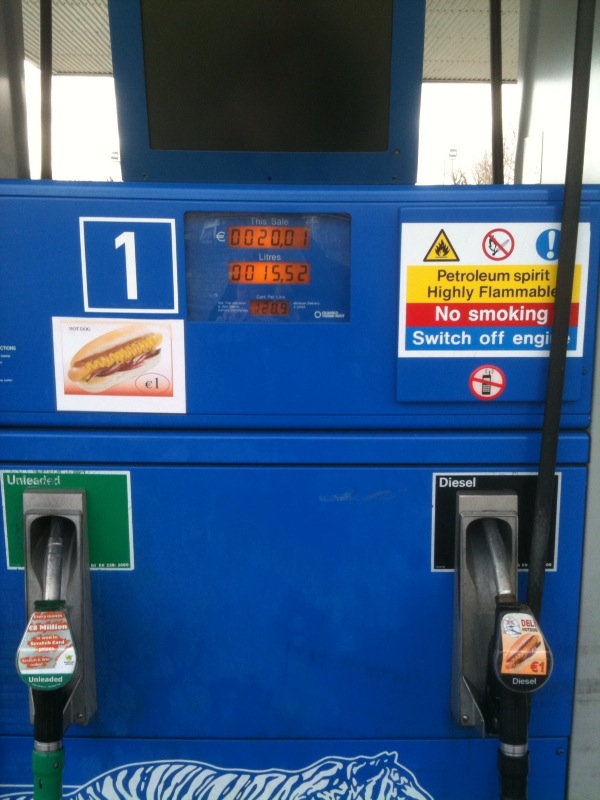
This sign now seems to be appearing regularly in petrol stations across the country. Presumably it’s because the owners are afraid that the mobile can somehow cause a spark, even though there is not the slightest bit of evidence that this can happen. Maybe it’s related to the demonstration involving mobile phones cooking pop-corn. We seem to be approaching the day when it’s not even Wikipedia we have to worry about as the source of all knowledge, but YouTube.
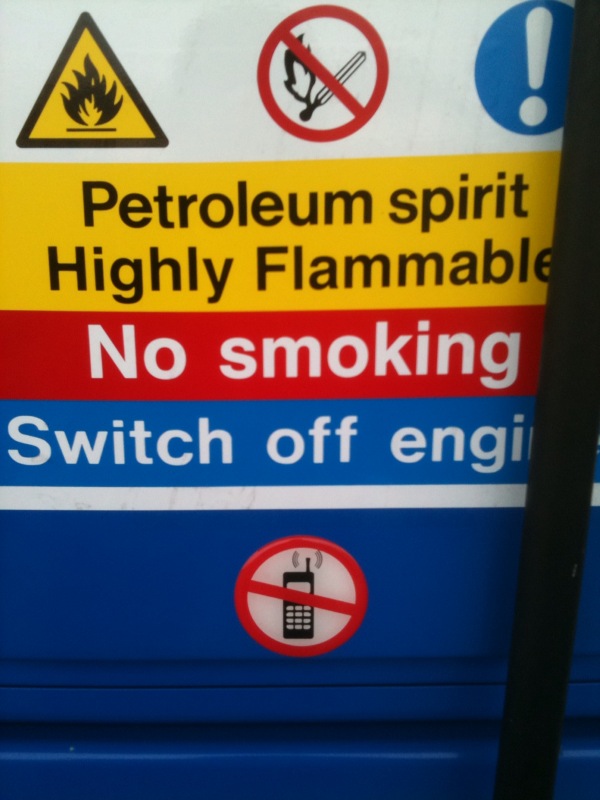
For the record, there is also no possibility that mobiles can cook popcorn, so yes, some of those videos may just be hoaxes.
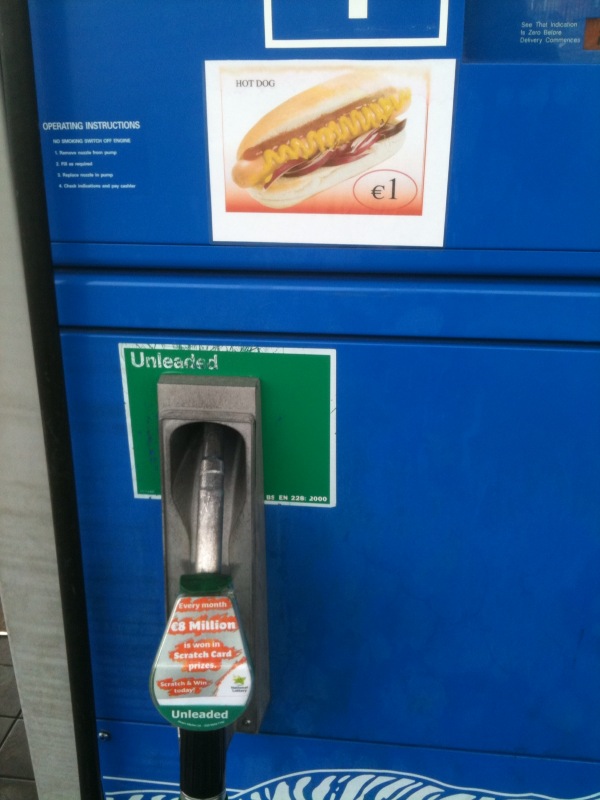
There does seem to be something not quite right about banning the use of phones while on the same pump having a picture of a big juicy hot-dog – I guess the heart attack you get in a few years’ time can’t be attritubed back to the station.
Oh, and don’t rub your bum on the car seat either.
We educators take this incredibly exotic jungle of knowledge called science and distil it until all the wonder has been removed and we are left with nothing but a heap of dry shavings. We then pour this into our syllabus and textbooks and make our students learn it off by heart so that it can all get vomited back up come exam time.
And then we wonder why so many young people don’t like science.
I would like to attribute that to somebody famous, but I can’t, ‘cos it’s mine. Which brings me to my apology.
I would like to apologise to students of secondary-school science everywhere – past, present and future, for having to put you through this process.
I would like to apologise for being a little cog in this horrible machine.
I would like to apologise for doing so little to change this, or even to raise it as an issue before now.
In my own little way I will do what I can to repair some of the damage, and show what science is like when the wonder is put back in.

Yes, yes, yes, yes!
Just read this online article from Simon Jenkins in the Guardian
I devour popular science, finding its history and its wonder a constant delight. . . . It is a mystery how so many science teachers can be so bad at their jobs that most children of my acquaintance cannot wait to get shot of the subject. I am tempted to conclude that maths and science teachers want only clones of themselves, like monks in a Roman Catholic seminary.
I couldn’t agree more. It is a sense of wonder in the world around me that has drawn me into science, and yet wonder is the one thing that is sorely lacking from all text-books and school syllabii. And we as teachers are doing absolutely nothing about it. We should be ashamed of ourselves.
Listen to all the big-wigs tell us why we need more students doing science – it’s the economy, stupid. Yet ask any kid why they are fascinated with science and the economy is not likely to come top of their list of reasons. It’s that word again – wonder. So why are we afraid to tackle it at school level? And why does nobody talk about it?
Heaven preserve us from engineers, university professors and politicians getting their grubby mitts on another science syllabus. Not unless they can first demonstrate a proven track recond on rating wonder as highly as a kid does. Not that we teachers have much to boast about in that regard either. It’s as though we try to hide our sense of wonder because somehow it doesn’t seem appropriate. Is it because we teachers like to give the impression that we have all the answers and therefore there should be nothing to fill us with wonder. I honestly don’t know. And I’m not even sure what I can do about it.
But I guess a good aul’ rant wouldn’t be a bad place to start.
Feynman, in this regard as in so many others, remains an inspiration.
The Royal Society will feature regularly in the news this year as it celebrates its 350th birthday.
Cambridge University astrophysicist Martin Rees is president of the Royal Society, so it was fascinating to watch him explain in an exclusive video interview why President Obama was right to cancel manned US missions to the Moon.
Wonder what Gil Scott-Heron would have made of it.
I reckon that if we really wanted to know what other life-forms exist ‘out there’ we might first spend a little more time checking out what is here and perhaps be a little more hesitant in destroying so many unexplored habitats on Earth. Not to mention spending a little more time and money on investigating our oceans.
 Think for Yourself