Month: November 2008

Colours from black and white? Say it ain’t so!

We had half a class the other day so we just played around with some equipment left lying about.

One such piece was a cardboard disc with black circles and shapes on a white background. If you spin it quickly you get to see coloured circles! It’s mad I tell you.

Only thing is, because it’s got to be a psychological effect it doesn’t get picked up on the camera.

Hates that.

Trainee teachers get a raw deal


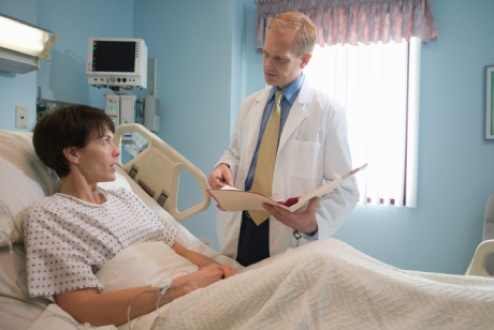
doctor-patient1

Does a medical student get to work on a patient/diagnose a patient for the first time unsupervised?

Does a trainee mechanic get to work on the brakes of a car for the first time unsupervised?

So why is a trainee teacher who is on teacher practice in a classroom, usually unsupervised?

Because the main teacher has buggered off, that’s why.
Sooner or later the Department of Education will have to clamp down on this, and we as professional teachers will have to toe the line. Now some of us spend this time productively, while more of us use it to have an extended coffee break, or if we get lucky we can even leave the school early or arrive late in the morning.

In fact if we plan it out properly in advance we can even give ourselves the day off.

Point is, this shouldn’t happen. In a training hospital there is an understanding that the ‘master’ doctor (isn’t ‘master’ a horrible term – or am I just too PC?) assumes responsibility for the trainee; shows him (or her) the ropes, and gradually exposes the trainee to a greater level of responsibility. Why do we get away with not doing this?
Yes of course I am generalising, but does anybody even know to what extent? Do some schools have a policy on this?

The temptation is often to give the trainee teacher a transition-year class and the rationale may be publicly that it is unfair to an exam class to expose them to a new teacher, which certainly seems reasonable, but then a transition-year class is always going to be more difficult to motivate – and discipline (could this add to the attraction of ‘fobbing it off’ onto a hidip?). So if we are sticking a new teacher with this class, the onus should be on me as the main teacher to remain in the class at all times.

It does create a slightly artificial atmosphere, but what I have found is that most of the time the students quickly forget about the teacher at the back, and just get on with on it. If the trainee-teacher has problems controling the class this will soon become obvious, with or without another teacher at the back.

Isn’t there also an insurance issue with leaving an unqualified teacher to run a practical session in a lab?

This brings up a second issue.
Why are these trainee teachers teaching classes at all?
Wouldn’t they be better off observing as many teachers as possible to critique the different teaching styles? After all, they can be ‘blooded’ at any stage but chances are they will never again have the opportunity to sit in on a colleague’s classes. I’m arrogant enough to think that a new teacher could learn something from observing my teaching style; maybe it’s only how not to teach a class – but that’s still a valuable lesson that otherwise may never be learnt.
A colleague of mine is hoping to initiate a group of like-minded teachers who are prepared to let colleagues sit in on their classes, but purely from a timetable point of view it may prove unfeasible.

At least it’s certainly a step in the right direction.

It’s almost 40 years since we first put a man on the moon.
Is it possible to create a space/forum/platform for teachers to discuss these issues?
How would we respond?
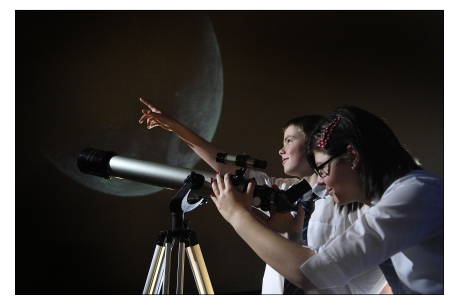
Free Telescopes for Schools – what a wonderful idea!

year_of_astronomy_2_thumbnail

A colleague reminded me recently that when you think about it, there are really only two concepts that fascinate young kids; Space and Dinosaurs.
Okay, so this is a gross generalisation, but with work with me here.

Somebody in England has cottoned on to the first part of this.

The Society for Popular Astronomy (SPA), Royal Astronomical Society (RAS) and Science and Technology Facilities Council (STFC) have teamed up to give free telescopes to 1000 secondary schools.

And in Ireland?
Don’t hold your breath.
But at least both of these topics are on the school syllabus right – especially seen as we seem to want to encourage more young un’s to take up Science?

Welllll . . . Umm . . . Ehhh . . .Hmmmm . . .

Too obvious I suppose.

It’s been a pretty cool few days

After a number of months  of trying (off and on, mind), I finally managed to get the url for the blog changed to thinkforyourself.ie
Thanks to my colleagues at St. Columba’s College English department for the idea.

After putting in quite a bit of work into Young Scientist Projects for the first time this year, we have had four out of the eight submitted accepted for presentation next January. Busy times ahead. They’re almost all in Second Year, and when we spend time on it in class, those not preparing for the Young Scientist Exhibition will be preparing for the Scifest equivalent next May.

Then I got a phonecall on Saturday from Aoife O’Donoghue, who is the Tyndall Outreach Officer, to inform me that one of my leaving cert students won first prize in the senior category of Science Snaps, their Science Photography competition (Shhh . . . Shane doesn’t know yet).
Not that I that anything to do with it mind; I tried to promote an internal Science-Photo competition at the beginning of the year and had the grand total of three entries. So at least this should help in promoting it if it runs again next year. And Mary Mulvihill over at Science@Culture might even be impressed with the quality of the entries.

And then I came across this on Youtube, and I don’t know why but I cried. My wife thinks it might have been the beautiful music in the background.

Play the survival game: a cool resource for teaching Evolution

darwin-game

The Science Channel have produced a wonderful learning resource on evolution here. I tried it with my Transition Year class and they found it addictive, as did my Leaving Cert Physics class when they walked in and saw it on the screen.  For what is arguably the greatest idea mankind has ever come up with, there appears to be remarkably few quality resources available online.

The Welcome Trust have produced some text-based resources here (top right of page), which isn’t quite the same thing.
Is it because we as teachers are not pushing to have it taught at all levels in schools that there are so few resources out there?
Or are there resources online that I just don’t know about?