Month: May 2008

Exploring the ocean’s hidden worlds


Another wonderful story from the World of Science:

Ocean explorer Robert Ballard takes us on a mindbending trip to hidden worlds underwater, where he and other researchers are finding unexpected life, resources, even new mountains.

I am very ignorant of what’s out there in the deep blue briny, but I do know of two wonderful sources of information in this regard; Redmond O’ Hanlon’s Trawler and Bill Bryson’s A Short History of Nearly Everything (get the illustrated version – it’s well worth the extra expense).

Ten great ideas revisited

The amazing thing about our science education is not that so many run away from it, but rather that any at all stick with it. We really do an exceptional job of sucking out all the good stuff.

There must be a website out there somewhere concentrating on the most wonderful ideas in science for the non-specialist, but I haven’t been able to find it.

So I’m going to do one.

Ten ideas. I’m sure the number will grow. Then link each to relevant external resources; these must be interesting, informative and aimed at an appropriate level.
For project work I could maybe get students to pick one which interests them, research it in detail and report back to the class.

Because I am fascinated by science, and am sick to death of teaching students how to measure the density of a stone.

I have put together a word document on this for a recent Fourth Year test; it’s a start.

Nuclear Fission resources

Cockroft and Walton experiment; Artificial splitting of the atom, as published in Nature:

The brightness of the scintillations and the density of the tracks observed in the expansion chamber suggest that the particles are normal a-particles. If this point of view turns out to be correct, it seems not unlikely that the lithium isotope of mass 7 occasionally captures a proton and the resulting nucleus of mass 8 breaks into two a-particles, each of mass four and each with an energy of about eight million electron volts. The evolution of energy on this view is about sixteen million electron volts per disintegration, agreeing approximately with that to be expected from the decrease of atomic mass involved in such a disintegration.

Experiments are in progress to determine the effect on other elements when bombarded by a stream of swift protons and other particles.

J. D. COCKCROFT.
E. T. S. WALTON.

Cavendish Laboratory,  Cambridge,  April 16.

Published in Nature, April 30, 1932 (pdf)

First controlled chain reaction; Eye-witness account: audio link

COMPTON: We entered the balcony at one end of the room. On the balcony a dozen scientists were watching the instruments and handling the controls. Across the room was a large cubical pile of graphite and uranium blocks in which we hoped the atomic chain reaction would develop. Inserted into openings in this pile of blocks were control and safety rods. After a few preliminary tests, Fermi gave the order to withdraw the control rod another foot. We knew that that was going to be the real test. The geiger counters registering the neutrons from the reactor began to click faster and faster till their sound became a rattle. The reaction grew until there might be danger from the radiation up on the platform where we were standing. “Throw in the safety rods,” came Fermi’s order. The rattle of the counters fell to a slow series of clicks. For the first time, atomic power had been released. It had been controlled and stopped. Somebody handed Fermi a bottle of Italian wine and a little cheer went up. One of the things that I shall not forget is the expressions on the faces of some of the men. There was Fermi’s face—one saw in him no sign of elation. The experiment had worked just as he had expected and that was that. But I remember best of all the face of Crawford Greenewalt. His eyes were shining. He had seen a miracle, and a miracle it was indeed. The dawn of a new age. As we walked back across the campus, he talked of his vision: endless supplies of power to turn the wheels of industry, new research techniques that would enrich the life of man, vast new possibilities yet hidden.

Any day your work gets an acknowledgement from Einstein is a good day

Cockroft and Walton resource

Einstein and Chain Reaction resource


Murray Gell-Mann – why I took Physics

Murray Gell-Mann, the Nobel prize-winning scientist who ‘discovered’ quarks and took the word from Joyce’s Finnegans Wake, thought that Physics at high school was “the dullest course I had ever taken”, and he only applied to study physics at university “to please my father”.
Taken from; When we were kids: how a child becomes a scientist.

I wonder how his physics teacher felt when he read that?

Here Gell-Mann talks about Truth and Beauty in Physics


Dublin Alchemist Cafe: Professor Steve Fuller

Hope to take myself into the city tomorrow for a little intellectual stimulation.

The Dublin Alchemist Cafe, as it says itself:

is a forum for the discussion of important and interesting scientific issues that is much more informal and accessible than a public lecture.

Tomorrow Steve Fuller, Professor of Sociology at University of Warwick will discuss Human Nature:

“There has been undoubtedly a recent rise in interest in biological approaches to understanding the human condition. Many, if not, most of these efforts attempt to reinvigorate the idea of ‘human nature’.  But is this idea feasible in light of recent developments in the biological and social sciences?  Regardless of the answer one gives, the question raises the larger issue of whether ‘the human’ is itself a category worth defending for scientific or even political purposes. I shall argue that ‘the human’ is indeed worth defending but that much recent thinking and research challenges rather than aids such a project”.

Professor Fuller has indirectly been responsible for introducing me to the schools of History, Philosophy and Sociology of science. I didn’t even know these areas of knowledge existed, but in hindsight this shouldn’t be too surprising; it appears that the Republic of ireland is one of the few countries in the western world which doesn’t have even one of these departments in one of their universities. Queens in Belfast has a History of Science department, or at least they had one ten years ago.

Anyway, back to Fuller; he tends to enjoy provoking scientists out of their comfort zone and forces them to defend not only what they know, but more importantly tries to get them to say why their area of expertise is more secure (‘better’) than other forms.

Lately he has been defending Intelligent Design as a legimate area of knowledge. Here he relates this discussion to the fall-off in the number of students taking Science at secondary level and in college.

Last-week-of-term activities

What do you do to entertain a class of sixth years who reckon they have earned the right to not work in their final week?
Today I introduced them to the intriguing character of Nikola Tesla

It seemed to go down well.


Tomorrow I’m hoping to try getting them to listen to a podcast; in this case it’s an RTE interview with Jocelyn Bell Burnell, an equally intruiging character but for a whole lot of different reasons. She discovered the Pulsar, a rotating neutron star, and should have received a Nobel prize for her work but instead it went to her supervisor. Instead of being bitter she is remarkable sanguine about the whole matter.

Oh, by the way, she’s Irish. So why is this not on the syllabus?

The proram is part of the Icons of Irish Science series, which was first broadcast in 2005, and is well worth listening to.


My tip for the Leaving Cert Physics paper

The Large Hadron Collider (LHC)  in CERN will be the world’s largest particle accelerator when its construction is completed sometime this Summer. It’s a pretty big deal if you are a particle physicist, and even if not you are still likely to be bombarded with the news when it is finally switched on.

‘Tips’ aren’t really a good idea for the Leaving Cert Physics paper, but if I had to guess I would suggest that something in this area is going to make an appearance on the Particle Physics question this year.

To find out why this is such a big deal you could do worse than watch Brian Cox talking at TED this year.
The Higgs particle isn’t on the syllabus but it should be. It’s probably the Holy Grail of Particle Physics. It aims to explain why particles have mass, which isn’t as silly as it sounds (apparently).

‘Course I could be completely wrong.


CESI Blog

CESI  (the Computer Education Society of Ireland) have just set up a forum for teachers at all levels (primary, secondary and tertiary) to promote the use of ICT and also to facilitate those who have ICT related questions.
They may end up having a blog for the more philosophical issues, and keep the forum for queries. Either way, it’s well worth subscribing.

Obviously you can unsubscribe at any stage.

Sign up here

It was set up using Googlegroups, and seems to be working very well.

Which got me to thinking:
Why is this facilty not available for teachers of Junior Cert Science. Particulary for clutz like me who have to teach a biology dissection, or for that matter for a Biology teacher who has to teach Electricity for the first time.
If nothing has been done by next September I may have a go at setting it up myself.

Afterall, if John Hegarty can do it for CESI, it can’t be that hard! 🙂

And then why not have one for a school science department themselves? What an excellent means of having an ongoing discussion between teachers who just don’t have the time to sit down with each other during the day.

One step at a time perhaps.

Congratulations Scifest winners!!!


I mentioned that I was trying to promote Scifest as a means of getting students to do real science as opposed to the learning by rote and following cookbook recipe-type so-called experiments. So after promoting it among second, fourth and fifth years, I ended up with about eight groups, of which seven pulled out when they realised the presentation was going to be held on a non-school day.

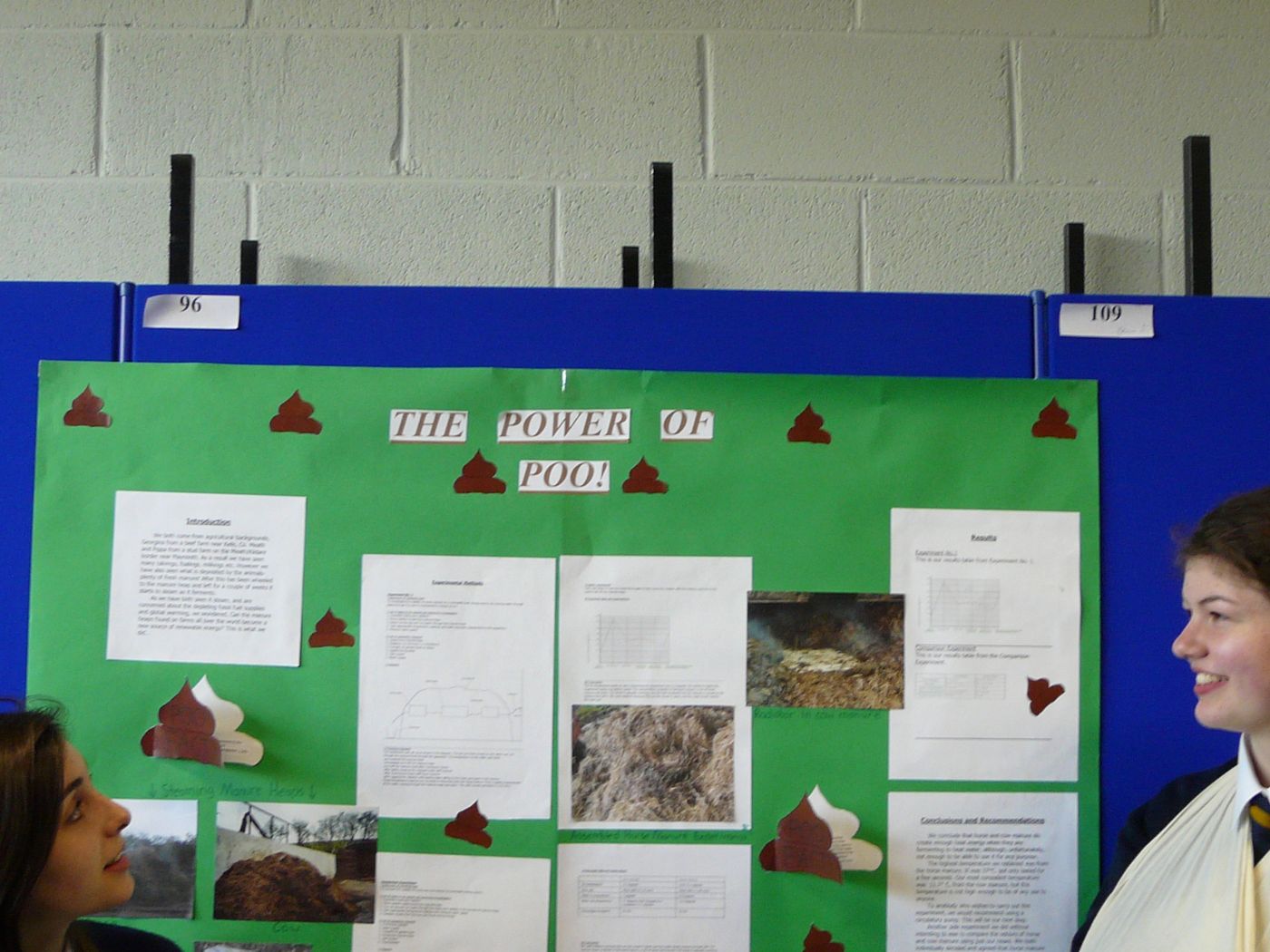
Which left us with ‘The Power of Poo’, a second-year entry from two girls; Georgina Gilsenan and Philippa Tuthill. This highly original project involved inserting a couple of radiators into the middle of a dung-heap, pumping water through the pipes, and noting the rise in temperature. The results obtained may not turn the planet off its axis, but there was a serious amount of science involved in controlling variables. They even tried two different dung-heaps; cow and horse!

And it won!
In three categories!
Best Junior Project.
Best overall Physics Project.
Runner-up in Best overall Project.

Unfortuantely I had to leave early in the afternoon and so wasn’t there for the prize-giving ceremony, and so don’t have any photos of the girls receiving their prizes, but if I talk nicely to their parents they might lend me some to put up here.

The irony is that after prodding and poking each of the other groups all along the way, only for them all to pull out, this was the one project which I had almost nothing to do with apart from submitting the entry.  There really shouldn’t be any teacher’s name associated with it – it really was all there own work.

Not that it will stop me shamelessy exploiting the publicity in school as a means of promoting the project again next year, with hopefully a little more commitment.

Learning to podcast

This is a short audio about forces for my Second Year students revising for Summer Exams. I did a bit of podcasting a few years ago but have forgotten how I made the pieces accessable. I also need to learn how to jazz these things up a bit.
This piece is hosted on the wordpress site itself, but I’d like to make it accessable via itunes. I tried this and five days ago received the following

Your podcast feed, [ https://ozymandias1.wordpress.com/feed/ ] was successfully added and is now under review.

Since then, nothing.

forcesone